Fan Engagement > Our Thinking > How One Podcast Got 46M Impressions On Election Night | The Rest is Politics, Full Breakdown Ep. 1
Key takeaways:
- Goalhanger’s live YouTube viewership was already often higher than Sky News, which is why leasing the audience to a media network never made the shortlist this time.
- The team admitted upfront they couldn’t outspend the BBC, CNN or Sky, and built the entire strategy around that constraint instead of pretending it wasn’t there.
- Sophie’s first instinct hearing the brief was “why do stuff like this?”, and that question is what reframed Dizplai’s role from vendor to genuine co creator.
- Steve’s framing of the whole production in one line: this was never built as a broadcast, it was built as a community programme.
- Owning the IP, the sponsorship rights, the audience data and the distribution opened commercial ground that simply isn’t available as a guest on someone else’s network.
- The strategic position was “the cool head in the room”, which is how you carve out alternative space when every other US election narrative is screaming at its audience
This production didn’t start with a blank page. It started with a decision. Goalhanger had already proved with Channel 4 that the The Rest is Politics audience would follow Rory and Alastair onto linear TV for the UK election. The question for the US election was simple: do it again, or stop leasing the audience to a media network and own the moment yourselves. In Episode 1 of Full Breakdown, we sit down with the people who made that call to break down how a 24-hour independent election stream actually got off the ground.
Ed Abis sits down with Dom Johnson (Goalhanger), Sophie Hammer (Head of Product, Platform at Dizplai) and Steve Munachen (Group Strategy Director at Dizplai) at Spotify Studios in London. The subject: how Dizplai and Goalhanger built The Rest is Politics’ 24 hour US Election Special, live from New York, without a legacy media network behind it.
This episode is about the idea. The why, before the what.
The Channel 4 partnership for the UK election had already proved the audience would follow Rory and Alastair onto linear TV. So when the US election came around, Goalhanger had a choice in front of them: lease the audience out again, or back themselves and own the moment. They picked the latter.
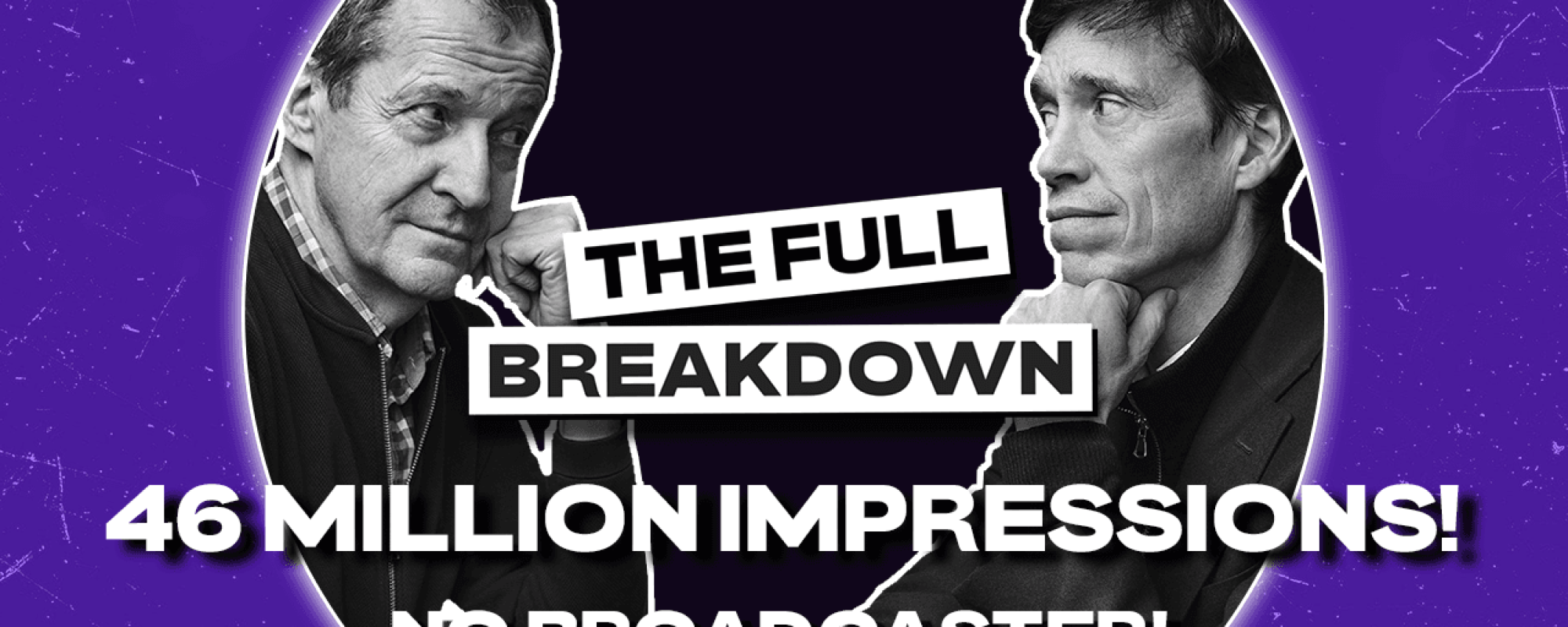
By the end of the 24 hours: 46 million impressions across all platforms, 34 million of those from social clips alone, over 2 million live viewers, 80,000 concurrent at peak, and 72,000 live chat messages. No media network in sight.
Watch the full episode below
Full Breakdown FAQs
What is Full Breakdown?
Full Breakdown isn’t a polished case study or a five-minute brand film. It’s something a bit more honest than that.
We sit down with the people behind a project; the strategists, the producers, the operators, the people who were actually in the room, and walk through how it came together. What worked, what didn’t, and what the team might do differently.
Each Full Breakdown is recorded as a single long-form conversation, then cut into a four-episode mini-series. Episodes run between seven and fifteen minutes, structured around four themes: the idea, the execution, the reflection, and the advice.
Who should watch Full Breakdown?
Anyone working in sport, media, broadcasting or the creator economy who wants to understand how ambitious live projects actually get built. If you’re a publisher, a rights holder, a creator or a brand thinking about doing something independent and at scale, Full Breakdown is designed to give you an honest account of what that takes.
Why four episodes rather than one long video?
Because long-form content has a drop-off problem, and splitting a conversation into four self-contained episodes solves it. Each episode has its own hook, its own story and its own reason to come back. The clips work standalone on social. The full series builds momentum on YouTube. And unlike a single video, a four-part series gives people a reason to come back.
What was the first Full Breakdown about?
The first series covers Goalhanger’s 24-hour US Election Special, the largest independent election broadcast in UK podcast history. The Rest is Politics went head to head with the BBC, CNN and Sky News with none of their broadcast infrastructure, and came away with 46 million impressions, 2 million live viewers and 72,000 live chat messages over the course of a single stream.
Our CEO Ed Abis sits down with Dom Johnson, Head of History at Goalhanger, alongside Dizplai’s own Sophie Hammer, Head of Product and Platform, and Steve Munachen, Group Strategy Director to unpack how it actually came together: the strategic thinking, the product decisions, and why building a community programme rather than a news broadcast made all the difference.
What makes Full Breakdown different from a standard case study?
Most case studies are written documents built around a brand narrative. Most behind-the-scenes videos are five minutes long and carefully controlled. Neither format does justice to projects that take months to plan and execute. Full Breakdown gives the people who built the work the space to say the things they actually want to say about it, including what they’d do differently and what surprised them. That honesty is what makes it worth watching.
Can my organisation be featured in a future Full Breakdown?
If you’ve worked with Dizplai on a project and you’re open to an honest conversation about how it came together, we’d like to hear from you. We handle everything: prep, questions, crew, edit, graphics and distribution. You walk in, tell the story, and walk out with a four-part series, a library of social clips, and a long-form asset that captures what your team actually built.
Get in touch at hello@dizplai.com