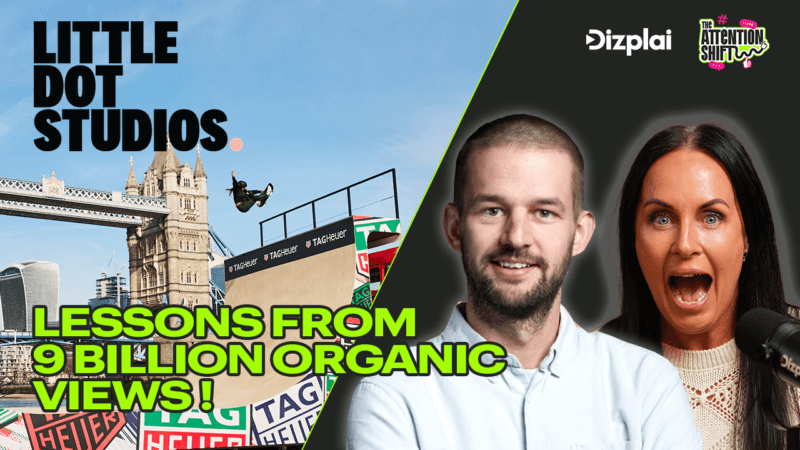


Fan Engagement > Podcasts > What 9 Billion Views Taught One Production Company About Fans, and What They Actually Watch | Robbie Spargo
Summary
- YouTube is now a TV consumption platform — content at 20 to 60 minutes outperforms both short-form and ultra-long formats
- The top 50 YouTube sports channels are almost evenly split between creators and traditional rights holders, neither side is winning.
- Super fandom beats scale: a viewer watching 20 minutes is commercially more valuable than thousands who watch for two seconds.
- Average view duration is the metric that matters, not raw views — because engaged fans generate more ad revenue, sponsorship value, and merchandise sales Owned and operated platforms are under growing pressure from AI summaries eating website traffic — unique utility is the only defence Social commerce is arriving in Western markets — TikTok and YouTube shops are turning passive viewing into purchase moments, and sports organisations who move early have the advantage
Transcription
Jo (00:01.705)
Hello and welcome to the Attention Shift podcast. And I’m delighted that I’ve got a very special guest this week. It’s just me, no Ed. So I am joined by Robbie Spargo who is co-managing director agency at Little Dot Studios. And I get to pick your brains all to myself, which I’m thrilled about. Thank you.
Robbie Spargo (00:19.362)
Thanks, Joe. Yeah, really great to be here and thanks for having me on the podcast. Really excited about having an interesting chat, hopefully about all things media and future gazing with you.
Jo (00:30.519)
future gazing. It’s my favorite thing to do. So yes, with that in mind, what a great tee up to set the context actually for this chat. And I am sure it is going to be jam packed. But yeah, that context setter and future gazing. One of the things that I do look forward to, and I’m genuinely not blowing smoke, I love a good report. I love a trend report. But…
you know, at the beginning of each year or at the end of each year, we’re all inundated with them. So I do tend to kind of filter them out, but little dots is one that I take the time to read and very often go back to because they are genuinely super interesting. So using the latest trends report as our jumping off point for this conversation, it’s fair to say, I mean, we’re all cognizant of the fact now that we’re media is undergoing a massive shift, fragmentation,
this shift away from the old centralized distribution, very much controlled and curated distribution that was how media was shared when we were young to this more fragmented, decentralized, community-centric platform strategy. But when you’re in media or when you’re in sports, that shift, it can be quite hard to pivot your kind of businesses when content is abundant.
when attention is scarce, it requires a whole different way of running a business when gatekeepers change or now you can bypass them or those gatekeepers have been replaced. Basically, it brings us back to fandom and this is what I want to start off with you because really, I think what Little Dot would acknowledge and you would acknowledge and I acknowledge is we’re now in the fandom business, but actually how you…
how you engage fandom, how you nurture it, how you build it, and then crucially, how you capitalize and monetize it is changing completely. So my first question to you, how and where is fandom being built in your view and in your experience at Little Docs?
Robbie Spargo (02:40.182)
Yeah, so I mean, for those of you who don’t know who Little Dot is, we’re a social media management and content creation agency. So our specialism really is in social media platforms. And a large part of that has been in YouTube over the years. So we’ve spent about 13 years on the platform creating channels one way or another, often helping traditional TV producers or traditional rights holders to navigate the transition from old world to new world.
Jo (02:45.567)
Mm.
Jo (02:52.073)
Mm.
Jo (03:09.054)
Mm-hmm.
Robbie Spargo (03:09.374)
Effectively, that has been a case of using platforms like YouTube, but also increasingly TikTok and Instagram as two key social platforms for us to nurture fandoms. And by fandoms, I think really it’s kind of about creating an engaged audience, an engaged community who want to consume your content, talk around your content, engage with other fans around the content and effectively have a direct connection.
Jo (03:17.503)
Mm-hmm.
Jo (03:29.439)
Mm.
Robbie Spargo (03:39.372)
with you as a rights holder or as a piece of IP. And that’s realistically where we’ve seen this sort of development of fandoms coming from and going towards really primarily anchored in social platforms, often through video, but not exclusively through video.
Jo (03:39.561)
Yeah.
Jo (03:50.025)
Mm.
Jo (03:53.567)
Mm.
And really when you think about what fandom is, like you said, it’s that connection, it’s community. And we used to do it in the physical sense. You’d go and stand on the terraces or the touch lines. And that was where kind of the seeds of fandom grew. But now…
Fandom can come from anywhere or your fandom itch, guess. It can be scratched by a great number of things. It can be short form video. It can be deep dives. It can be creator content. So actually it’s a whole new skillset where rights holders and where media is concerned in like how you do connect and how you engage communities through video or through audio, but through all of these different platforms where fans now live their media lives. Just tell us a little bit about how YouTube
has grown as that tool within that kind fandom, those fandom mechanics.
Robbie Spargo (04:49.27)
Yeah, we’ve seen YouTube change a lot over the years. So we have this fortunate position of having thousands of channels within our network, about nine billion organic views going through our systems every single month. And so we have this ability to see how YouTube is changing. And about two years ago, we spotted this seismic trend and change towards ultra long form content really dominating on the platform.
Jo (04:57.929)
Mm!
Jo (05:07.007)
Mm.
Robbie Spargo (05:18.274)
And we suddenly had this thought that, well, it really looks and feels as though YouTube is becoming more and more a TV platform. And the rationale for them doing that is pretty clear, right? If it’s like TV, then advertisers are going to want to move their TV advertising budget more onto YouTube. Equally, if it’s like TV, people are likely to be sitting down watching on the big screen where they engage for longer, where you can sell them more ads, serve them more ads.
Jo (05:34.301)
Yep.
Robbie Spargo (05:45.1)
and where advertisers are willing to pay a premium for having their advert on a really nice premium TV device. But effectively, it sort of heralded this shift towards YouTube as a TV consumption platform. And we have seen like further shifts to that over time where it used to be we saw this direct correlation between video length.
Jo (05:51.689)
Mm.
Jo (05:58.485)
Yeah.
Robbie Spargo (06:05.966)
and average views and RPM, which meant that actually for a period we were putting out three hour long videos onto YouTube and they were our most successful pieces of content. That has changed slightly and we put out a white paper earlier this year which talked a little bit about some of those changes where actually the trend of content consumption is much more correlated to TV lengths of viewing.
Jo (06:07.625)
Mm.
Jo (06:12.531)
Yes.
Jo (06:34.228)
Yes.
Robbie Spargo (06:34.58)
traditional 20 minutes, half hours, hour long pieces of content and not those ultra long marathons that we once saw. But effectively that trend of YouTube becoming TV is very much entrenched and I think we all see it, we all see it developing.
Jo (06:40.585)
Mm.
Jo (06:48.347)
Yeah, mean, I think, sorry to interrupt. think just from a consumer point of view, not even as somebody who works in the industry, I feel it in my own consumption. mean, YouTube very often is the first app that I see when I turn on my connected TV. It’s not necessarily iPlayer or ITVX anymore, it’s YouTube. And I mean, we could debate the whole podcast on whether YouTube is TV. I love dipping in and out of that.
debate just because it’s quite funny to read the back and forth on LinkedIn amongst particular individuals. But there is no getting away from the fact that this YouTube on TV, it’s increasingly dominating the biggest screen in the house, in the living room, which in turn, as you’ve said, is altering the kinds of content.
that work best on YouTube. And even Neil Moen has said, you know, we’re moving to more of a TV, kind of premium TV-like experience. Now it’s interesting what you said, because I remember being at that breakfast at Little Dot Studios about 18 months ago, where you were talking about the three hour videos and how much better they monetized versus a 20 minute video. Interesting what you’ve said, how we’ve gone through another revolution of that again, and we’ve seen that come back down to more TV-like durations. Well, I don’t watch three hour.
stints on TV I tend to watch, yeah, one or two episodes of 30 minutes, maybe one, one hour, and then I have to go off and do other things. So it’s interesting how even that is beginning to mirror the old TV-like consumption. With that in mind, I want to dive into how this kind of, creators have really led the way on this.
Robbie Spargo (08:22.606)
Mm.
Jo (08:32.499)
but also now we’re seeing traditional media lean into YouTube. We’ve got two different sides of a similar coin, both of which can learn from one another. And I kind of, when I was making my notes for this conversation, I was kind of looking at it as this kind of creator slash traditional media alliance, because you’ve got traditional media that still produces strong IP. You’ve got the badgers of this world, the BBCs, who…
have that deep storytelling capability and those editorial standards that they’ve crafted over decades. But then you’ve got creators who disintermediated them on YouTube for a long time and who own attention at scale and the traditional media kind of needs that. But those creators don’t necessarily have that experience that traditional media has in building IP with narrative depth or…
format potential capability. How do you see those two sides coming together as little dot who have been in the middle actually for a long time?
Robbie Spargo (09:31.476)
Yeah, well, I think you’re bang on in that sort of portrayal of those two different worlds and what they can learn from each other. And I did something similar at start of this year where I looked at the top 50 YouTube sports channels and it’s almost even split between creators and traditional rights holders in that top 50. And so you can see neither one is better than the other, neither one is sort of more loved or being consumed more than the other or winning out.
Jo (09:45.342)
Mm.
Wow.
Jo (09:59.68)
Mm.
Robbie Spargo (10:00.142)
between creators and rights holders, they both have a place there. But I guess the question really is, what can they learn from one another? And in particular, what can traditional rights holders learn from creators when they’re trying to make a transition into a YouTube first world in order to get the best out of the platform? And I think there’s loads they can learn. Like, one of the things that YouTube creators are really good at is that building of community and building of fandoms.
Jo (10:15.795)
Mm.
Jo (10:25.789)
Yeah.
Robbie Spargo (10:26.744)
talking to audiences and having a one-to-one relationship with them. That’s much harder for a rights holder to achieve because they are not individuals, they are brands and they curate swathes of content that is from disparate sources and disparate personalities. But there must be other ways that they can create that sense of community, whether it’s through presenters or whether it is through engaging, bringing…
Jo (10:36.403)
Yeah.
Jo (10:44.307)
Mm-hmm.
Robbie Spargo (10:50.744)
comments from audiences into their content responding to the comments and actually making it more of a two-way dialogue. And then there are things like production values as well. Traditional rights holders still rely pretty heavily on TV quality production values. I don’t necessarily mean… Effectively, I don’t think that they need to quite as heavily. What they can learn from is the way that YouTube is produced, not necessarily in terms of like…
Jo (10:53.865)
Yep.
Jo (10:57.407)
Hmm.
Jo (11:06.611)
Yes.
Robbie Spargo (11:20.172)
the quality of the visual image, which is improving every single day for YouTubers as technology becomes more accessible and cheaper for them to use. But in things like how do you make sure that at the start of your video, you have hooked people in and they want to watch for 20 minutes and not turn off after five seconds. And you’ll see every single YouTuber has an edit technique that responds to that. How do you make sure that your cuts are pacey enough to retain that level of engagement throughout a piece of content?
Jo (11:22.228)
Yeah.
Jo (11:35.199)
Mm.
Jo (11:39.102)
Yeah.
Jo (11:43.443)
Absolutely.
Robbie Spargo (11:48.504)
and the YouTube analytics gives you the tools and the information for you to be able to do that. So how do you use that information to make your programming better and better and better and more and more engaged? These are things that think traditional rights holders can learn from from creators and bring into what they do in order to navigate this transition into a slightly different world.
Jo (11:57.663)
Mm.
Jo (12:03.38)
Yes.
Jo (12:08.667)
It’s a visual language, isn’t it? YouTube has pioneered its own visual language and even that has evolved and changed over the years from those kind of short, punchy, almost kind of screaming at you, attention grabbing formats, to now it’s being refined. And this is one of the things that I think perhaps traditional media hasn’t really understood about creators is they themselves are learning how to refine making their content.
as it’s increasingly being consumed in longer blocks on TV, like we said, feeling more like TV, it is not morphing into TV. It’s moving that way, but in itself it’s evolving. And that storytelling capability, even within sports that creators bring is something really interesting that I think traditional media who have always produced in a certain way and it’s for your broadcast, really can learn from. But similarly, I think creators, again,
They own the attention and they own those communities, but they’ve got a lot to learn from the more kind of traditional way that sports has been, you know, kind of built over the years. Who do you think in terms of whether it’s just someone that you observe or maybe a rights owner that you work with, who’s doing that well? Who’s leaning into kind of learning from creators or using them in your view?
Robbie Spargo (13:34.284)
Well, I was thinking the other day about how it’s slightly mad that in the UK, where CBS is not a broadcast channel, people still refer to CBS’s coverage of the Champions League. And I think one thing they’ve done extremely well is to effectively adapt what the sort of sensational and humorous and slightly bombastic way of presenting and talking about sport that creators have.
Jo (13:46.302)
Yeah.
Jo (14:01.192)
Yes.
Robbie Spargo (14:02.016)
and bring it into their programming with Thierry and Mika Richards and enable that and empower it and then bring it to audiences on TV screens but also bring it to audiences through social platforms. And it’s kind of a way that I think YouTube, that grammar, that tonality, that culture is actually really having an influence in more traditional media. they’re a really good example of that in my view.
Jo (14:06.451)
Yeah.
Jo (14:13.033)
Mm.
where I discovered it.
Jo (14:22.419)
Mm.
Jo (14:30.621)
Yeah, I would agree actually. Five, six, seven years ago, you wouldn’t have seen content on traditional media and traditional broadcast packaged in that way at all. And it does feel like something that they’ve borrowed from and they’ve woven into it. really, yeah, that was how I discovered that particular show. it Kate? She’s called Kate as well, yeah.
Robbie Spargo (14:51.822)
Yeah, yeah, I understand too,
Jo (14:53.775)
And I discovered it because it tracks on social because it is so good. It’s got that kind of almost in the, you’re in the pub chatting to your friends about sport kind of feel about it, but with a level of production quality that we’re used to seeing more on TV. And that mixture is really quite compelling.
Robbie Spargo (15:12.974)
And that’s what you find with creators as well is that they feel like your friends. They feel like, you know, for a 14 year old, it’s someone who that they would have a laugh with in the playground. It’s that kind of you’re on a level with those creators. And I think that’s the thing that they do really well in order to enhance engagement and build communities and trying to bring that into more traditional spheres, I think, will really help help re-engage with.
Jo (15:17.309)
Okay.
Jo (15:24.351)
Mm.
Jo (15:32.905)
Mm. Mm.
Robbie Spargo (15:42.526)
generation that kind of expect that type of relationship with talent on their screens.
Jo (15:47.635)
Yeah, agree. we, mean, you’ve seen it the, you know, with people like the rest is football and the overlap as well, who…
came from a traditional media background, lent into social and now in the rest is football’s case, they’re kind of hopping back onto Netflix to do a show throughout the World Cup, even though Netflix haven’t got any World Cup broadcast rights. it’s interesting how there’s beginning to be that crossover and it’s great that those two sides are coming together ever closer. wanna go into this, I mean, data. One of the great byproducts of
technology and the increase in the number of platforms is the amount of data. And I started my career in traditional broadcast where it took a long time. I mean, you had overnight, but it took a long time to get meaningful data. a lot of it was only top line. And very often there was a massive lag, often of weeks before you got meaningful viewership data. Now, of course, we exist in a media landscape where very often data and feedback is almost immediate.
How does Little.Use that? I mean, we can drown in data and sometimes it can send us off in different directions and it can almost be a red herring, but you’ve been doing this for a long time. So how does Little.Use that kind of data and insight to then inform this distribution strategy, which is now much more nuanced and sophisticated and complex than ever when you’re trying to reach fans and build a community that then ultimately you can monetize.
Robbie Spargo (17:24.886)
Yeah, well think we’re very lucky to have so much data at our fingertips, but also I also believe that the experience we’ve had on YouTube, whose data platform in YouTube Analytics is probably the best that there is, has meant that it’s sort of become part of our DNA, that we look at data fairly obsessively, we try and draw conclusions from it, we take those conclusions, turn them into actions and then measure the results of those to see whether it’s delivered what we thought it would deliver.
Jo (17:39.167)
Mm.
Robbie Spargo (17:53.004)
And so we have that kind of feedback loop, which, you know, quite frankly is often missing, not just from TV where data can be quite limited to how many people tuned in last night based on a panel, or even on web and OTT services where the data and the scale just isn’t quite as rich or as large as it is on a platform like YouTube. And so we spend quite a lot of time looking at data, not just from YouTube, but even from Instagram and TikTok and seeing things like per content type.
Jo (17:53.054)
Mm.
Yes.
Jo (18:04.639)
Mm.
Jo (18:19.529)
Yep.
Robbie Spargo (18:22.334)
how are viewers engaging with a piece of content, how are different types of viewers, how are US viewers, how are under 25 viewers engaging with personality-led content versus highlights versus this driver or this team really trying to understand how is it that we can take insights from all the data that’s being provided us and weave that back into our distribution strategy and even into the production strategy.
Jo (18:28.319)
Hmm.
Jo (18:38.015)
Mm.
Robbie Spargo (18:49.122)
we get these retention graphs where we can see where people are clicking off videos and we can go to those attention graphs and take them to producers and say, if you’re filming from this angle or if you’re making this type of cut, you’re impacting retention or you’re improving retention. And that’s then a great incentive for them to creatively adapt around that insight to change how they produce content. So it’s a really valuable tool to have. And because of that scale that we have, we also…
Jo (18:54.269)
Yep.
Jo (19:04.777)
Yeah.
Jo (19:11.172)
Mm. Mm.
Robbie Spargo (19:19.192)
have been able to develop some proprietary tools. So we’ve got some, we call it CHIP, which is our channel intelligence partner, which takes all the data, distills it down and gives you some actionable recommendations at a top level as to how your channel is performing, what improvements you can make in order to enhance it and improve it and make it better. And then we can start, you know, in due course, you can start to build in AI-led improvements.
Jo (19:30.654)
Yes.
Jo (19:38.697)
Yeah.
Robbie Spargo (19:46.798)
to those insights as well. So if we discover that your tagging strategy isn’t quite up to scratch, well, here’s a button you can press in order to use an AI tool that’s going to integrate with your channel to try and improve some of those tags and monitor it and improve it over time. So the data that we have is hugely powerful. And I think on social sometimes gets underplayed as to just how powerful that data can be.
Jo (19:49.247)
Hmm.
Jo (19:55.039)
Mm.
Jo (20:06.815)
Hmm.
Jo (20:11.357)
Yes, I think it’s easy to get overawed with data, both the amount and the complexity of it. But what’s interesting that you’ve just touched on that I often find is kind of missed is ultimately it is a tool. shouldn’t be leading you. You should be using the data to lead kind of improvements, like you say, better shot angles, different ways content is produced and edited. Ultimately, in service of the fan.
to make the experience better for them on the proviso that actually if they’re having a better experience, they’re more likely to stay with you and they’re more likely to spend. So that data, it then needs to become that pragmatic, actionable business intelligence to allow you to make decisions as a business that helps improve your customer, your fan experience. And I think…
you can almost get too bogged down in the data side of it and forget to do the rest of it, which is something that I think directly impacts your commercial structure in sport. I’d written a note here and it’s interesting in our kind of pre-chat, I’d put, you
where is the value derived from in this new fan ecosystem? And you also said something similar in our pre-chat was, super fandom is the new currency of media. And that almost was exactly the same as the note I’d made. So kind of that statement, explain what that means in terms of your point of view. Super fandom is the new currency of media. I think it’s a great phrase. Dig into it a bit, explain the thinking behind it.
Robbie Spargo (21:46.126)
Well, I guess we see most of the commercial value from a fan, quite honestly, coming from engagement and referred to earlier in terms of advertising impressions. If you’re watching for 20 minutes, you’re a super fan and you’re going to get more ad impressions and therefore you are more valuable than someone who’s consuming two seconds of your video on TikTok where there is no monetization whatsoever. And so I suppose that is one example of how a
Jo (21:55.071)
and
Jo (22:02.42)
Mm.
Jo (22:08.19)
Yep.
Robbie Spargo (22:11.886)
engagement, becoming a super fan is going to lead to you becoming more commercially valuable. And I think we have to nurture that as much as physically possible in order to drive not just advertising revenue, but also merchandising sales, attendance, the sponsorship value. If you are able to show to a sponsor that you have super engaged fans who are watching 20 minutes consuming all of your content on a repeat basis, that’s more valuable to them than just a superficial
Jo (22:17.021)
Yeah.
Jo (22:27.369)
Yep.
Jo (22:34.237)
Mmm.
Robbie Spargo (22:41.0)
a superficial affiliation and someone’s seen that.
Jo (22:42.909)
Yeah. And brands are beginning to request proof of that increasingly, right?
Robbie Spargo (22:48.238)
Absolutely, yeah, we’ve seen some of our partners have engagement as one of their core metrics that they take to commercial partners as a differentiator versus where they could just achieve scale through programmatic media buying.
Jo (22:53.715)
Mm-hmm.
Jo (23:00.305)
Absolutely. I was at MIP London recently listening to a talk by Arcade Media who are obviously behind the Sidemen. And one of the points that they made, I think it was Victor Bengtsson, said that they care less about number of views now and it’s more about average view duration. Because that really is the metric that better reflects fandom.
that depth of engagement. If you’ve got fans that watch 95 % of every single video and only really navigate away when they know it’s coming to an end, that is of more value to an advertiser than 10 million views where they’re only watching 20 seconds.
Robbie Spargo (23:44.726)
Yeah, yeah. think the only caveat to that is there is still significant value in scale and reach. And, you know, we use all social platforms and it’s interesting how they achieve slightly different things. There are other platforms, particularly Instagram, where it just achieves phenomenal scale. And it might not be 20 minutes that people are spending on your post because it’s one photo, but they are seeing your post and being reminded of you as a brand. And I think that still has a role to play within this.
Jo (23:52.191)
scale. course.
Jo (24:03.807)
Mm.
Jo (24:07.721)
and
Jo (24:13.938)
Of course.
Robbie Spargo (24:14.56)
ecosystem. It’s just that, like, quite frankly, you then need to get that person who has seen that one image to engage with you in a manner of a superfan. And that might well be watching a long video, or it might be attending a game, or it might be spending ages researching players through your website. It might be engaging with your fantasy app, where, again, like, engagement is super high and really great way to get people properly invested in a sport for life.
Jo (24:24.191)
Mm.
Jo (24:33.299)
Mm.
Jo (24:37.289)
Mm.
Robbie Spargo (24:44.526)
I think that it still has a role to play with the new ecosystem, it’s just that I think probably the value is coming more at the bottom of the funnel as it always has done where people are spending more time and are more engaged.
Jo (24:44.713)
Hmm.
Jo (24:53.385)
Yeah.
I want to just dig into that ecosystem point because it’s something that again that I talk about a even, you know, in my kind of
Even though I’m working in sport, as you know, I came from kind of kids media and when you’re managing kids media franchises, you’ve got to think about your content, you’ve got to think about your movie, you’ve to think about your video game, you’ve got to think about your merch sales. Very much that old Disney flywheel that we see do the rounds on LinkedIn periodically. It does really typify what an ecosystem is and that applies equally in sport. if you were, we are crystal ballgazing, we’re looking into the future here, you know.
What will you see as kind of every major sports organization as needing in its ecosystem? Are they gonna need their own streaming service? Hopefully they’re gonna need socials, they’re gonna need YouTube. Of course, then you play into that, the live games and your season ticket holders. know, from just probably less from a live events point of view, but from a media point of view, what are those nodes on that ecosystem that you think all sports organizations are gonna need in the future if they haven’t got them already?
Robbie Spargo (26:00.512)
I think it’s going to vary depending on the type of sport, what rights they have, what role they play, whether they’re a league, are they a club, are they a player, are they a creator, a broadcaster. It’s always going to vary depending on that. I think the media rights side of things is not going away, and I think there is still huge value in reaching audiences through a third party distribution platform. And I just want to sort of…
Jo (26:06.398)
Mm.
Jo (26:12.201)
Mm.
Jo (26:15.849)
Yeah.
Jo (26:21.459)
Mm-hmm.
Jo (26:27.07)
Yes.
Robbie Spargo (26:30.03)
shout out that more traditional ecosystem as brilliant curators of content. They have been for years and I think they can still be in the future. They can curate conversations around sport in a way that a rights holder can’t. They can’t take this kind of outsider perspective or punditry view about the sport that they’re representing because they are the sport itself. They have a sort of a government governance.
Jo (26:39.795)
Agree.
Jo (26:44.275)
Good.
Jo (26:52.915)
Mm-hmm.
Robbie Spargo (26:57.73)
remit to fulfil that just requires them not to go too far outside of a particular lane. So I think media rights is still hugely valued. The question is going to be what commercial value that can bring. And in my view, in future, it will only be the top tier sports that are deriving significant media value. The rich will get richer and, unfortunately, everyone else. And then everyone else, think, will be looking at media exposure really as a way to
Jo (27:04.159)
Hmm.
Jo (27:14.951)
Yeah, we’re seeing that, isn’t it? Yeah. Yeah. And then the middle kind of disappears. Yeah.
Jo (27:25.94)
Mm.
Robbie Spargo (27:27.096)
drive reach and engagement for other nodes of that ecosystem, be it sponsorship, be it e-commerce, be it attendance and participation even. I think that you touched on owned and operated platforms and I think it’s a really interesting debate as to how much value they will bring within that ecosystem. And there is definitely a role for them to play, but I think it’s really challenged. And the reason it’s really challenged is you can see at the moment
Jo (27:33.695)
Hmm.
Robbie Spargo (27:56.674)
the changes that are happening within Google search around AI summaries that is just greatering traffic for news publishers as well as for all other website providers. So what is it that you’re providing that goes beyond the AI summary, that goes beyond the content that people will get in their Instagram feeds? And realistically to provide and produce that content, you have to think quite creatively, you have to be quite inventive and you have to invest quite a lot of money in order to create something of value.
Jo (28:22.367)
It’s expensive.
Robbie Spargo (28:26.166)
And I think about things like fantasy apps or games or deep sort of data information, a great UX that allows you to engage better with that sport as being something you could do on a website or an app that you just couldn’t do through social platforms or through any other means. And so that’s where I see the role of owned and operated developing over the years as part of that ecosystem. But unfortunately, I do think it is challenged. There’s no doubt about it.
Jo (28:30.313)
Yep.
Jo (28:35.647)
Yeah.
Jo (28:44.67)
Yeah.
Jo (28:51.678)
Yeah.
Jo (28:56.031)
I would agree. And if you assume that the owned and operated platforms are the place where you have to service that super fandom, because if you’re going to justify them paying, say, a monthly subscription or an annual subscription, as you said, you’ve got to justify them subscribing as super fans. And that means they’re going to want a lot. They’re going to want…
the behind the scenes stuff, the level of data, the level of access that they cannot get across those social platforms. And I wonder if a lot of rights holders perhaps don’t realize that that comes with usually a pretty hefty price tag and also an endless feeding of that fandom. Super fans by very nature are voracious consumers. Therefore you have to feed that in order to justify a subscription. So yeah, I think it’s…
It’s not the only option, it is an option amongst that whole ecosystem to grow your fan base as a whole, but not to be entered into lightly. Now, I knew that we’d run out of time and I’ve got a gazillion things that I still want to ask, but I want to go back to…
Your report again just to to pull out something that I thought was super super interesting We’ve very often talk about how media or different types of media or different platforms as being Cannibalistic and there’s assumption that you know, if you’re scrolling your phone You’re not watching the live game on the TV and one takes attention away from the other I don’t necessarily think it’s so binary or cut and dried and there was an interesting point in in the report about this kind of
convergence, this kind of social viewing convergence. Gosh, you’ve only got to look at kids, how they are prolific, multi-screeners and multi-absorbers of media.
Jo (30:48.167)
and very often combine it in their own kind of unique ways in the sense that you can watch very often two screens at the same time. You can be shopping or you can be gaming. You can be chatting with your friends about what’s going on over there on the big screen. And maybe you’re also now buying. Talk to us a little bit about where you see all of this going and how it might apply in sports as well.
Robbie Spargo (31:11.18)
Yeah, mean, I think so e-commerce, which you reference there, is an interesting area because I think it’s taken years and years for people to feel comfortable opening their wallets online and then secondarily on social platforms. And I think actually, particularly on social platforms, people have felt loath to pay for anything at all. And I think that is starting to change as it becomes more frictionless.
Jo (31:25.311)
Mm.
Jo (31:34.483)
Yeah.
Robbie Spargo (31:38.796)
And as people sort of gain confidence and trust that what they are investing in or what they open their wallet for, like actually deliver something back in return. And we can see it with TikTok where the amount of people who will say, bought this on TikTok or I found this through TikTok shows that there is a huge e-commerce engine there and a huge power in the platform to actually sell physical products.
Jo (31:47.913)
Mm.
Mm.
Jo (31:58.048)
That’s me.
Robbie Spargo (32:07.118)
that in this country at least is only just starting to be realised. We see it a little bit on YouTube as well where we’ve launched YouTube shops where a rail of products can sit beneath a YouTube video and even if it’s not getting loads and loads of click-throughs and purchases and conversions it’s doing a job of advertising. There are products available to buy and you may want to go and buy these subsequently or you may start to an interest in…
Jo (32:11.411)
and
Jo (32:28.081)
It’s awareness, yeah.
Mm. Mm.
Robbie Spargo (32:34.63)
a team jersey or a mug with a brand on it. So I think there’s an increasing role for social to play in e-commerce and actually starting to drive sales. And if nothing else, we’ve got case studies from other countries of where this is a huge success and a huge revenue driver. And there’s no real reason why that shouldn’t be the case in Western markets, in the UK, in other markets, as well as in countries like China.
Jo (32:53.887)
Mm.
Jo (32:58.559)
Mm.
Jo (33:03.273)
Hmm. It’s, mean, that, kind of e-commerce or content commerce almost, it’s, it’s emerging, but even I can see the potential and the possibilities if they join together. You, you’re, you’re watching the Champions League final and you can see on your phone that there’s product, related products available, whether it’s media-based or whether it’s some, you know, kind of, event, merch.
And actually all of these things are beginning to be used much more seamlessly in concert together, kind of, so that it doesn’t intrude or interrupt your experience, but it sits alongside. And it’s interesting your point about, even if you don’t press by at that time, which is increasingly frictionless, actually even just it being there.
potentially plants a seed and then you come back and maybe a purchase happens subsequently. I think it’s…
Robbie Spargo (34:00.174)
I think you sort of alluded to it there. It’s kind of also question about what you’re buying as well. And sometimes wonder whether things like jerseys or merchandise or fashion items, they’re actually in a way the hardest things to sell because A, they’re pretty expensive, but B, you want to know that it looks and it feels good once you’ve bought it. So I think there’ll be some interesting developments in terms of what products.
Jo (34:07.263)
Mmm!
Jo (34:21.245)
Mm. Mm.
Robbie Spargo (34:28.896)
sports rights holders and others look to sell through those platforms that beyond just jerseys and fashion items to things that maybe take a little bit less thought and worry and panic to buy and a little bit less a little bit more frictionless to purchase.
Jo (34:33.459)
Yeah.
Jo (34:37.182)
Mm.
Jo (34:44.061)
Yeah.
Jo (34:49.203)
Yeah, and leaning into the storytelling, this is one thing that you see kind of coming out a lot of these live shopping apps. It’s less about the must buy it now transactional kind of FOMO driven behavior. And actually it is much more about the narrative and the storytelling around it, whether it’s the person who’s selling or, but again, that’s interesting in sport. know, when I think about big games that
like El Classico, where there’s a lot of history and rivalry and drama and storytelling around it, actually that can be woven then into potentially what products are offered and sold around that piece of content that might not just be a jersey, it might be something else. it’s interesting how, again, a lot of it comes back to that storytelling in and around sport and knowing what need state your fan is in at that particular time when they’re watching and what kind of products are they likely to be
open to buying at that moment. think it’s fascinating. Definitely something that I see emerging in the next few years. Okay, well listen, we’re at time. I think we should perhaps revisit this conversation in a few months and particularly with that kind of social and viewing and buying convergence, seeing how that’s shaping up in sport. But in the meantime, thank you very much Robbie for joining us today.
Robbie Spargo (36:11.032)
Thank you for having me. It’s been great to chat. I really enjoyed the conversation.
Jo (36:15.293)
Me too, me too. And this has been the Attention Shift. And you can reach us if you’ve got any comments or let us know what you thought about this discussion at hello at attentionshift.media. And please do tune, like and subscribe and join us for the next one.
Thanks Will.

- Tags: Brands & Agencies, Creators, Media Networks, Sports