

Fan Engagement > Podcasts > Marc Jacobs’ Social Bet, How Publishers Win Subscribers in 2026 & Has Football’s Bubble Burst?
Summary
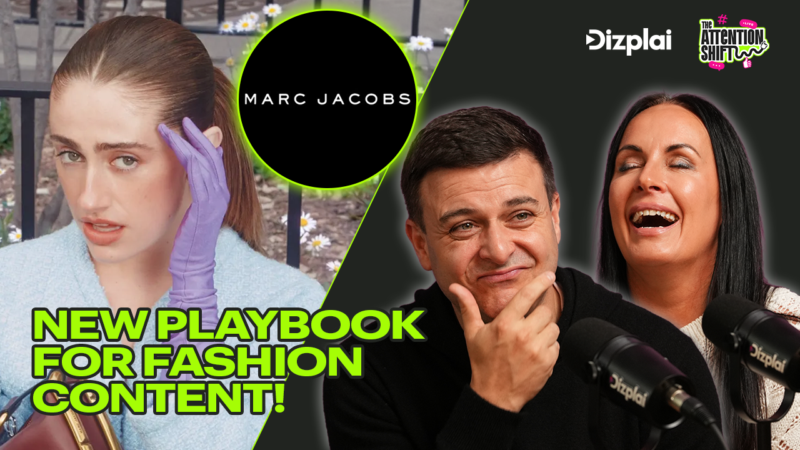
- Marc Jacobs’s New Content Gamble: The Scene isn’t an ad, it’s a Rachel Sennett-fronted micro drama. Boring ads cost 27% more to convert and top entertaining brands have double the preference of the bottom 30. P&G, Crocs and Maybelline are running the same play. When did brands start competing with creators instead of each other?
- PayPal’s 25 Billion Receipts: PayPal Curated Ads now matches a Connected TV ad against 25 billion annual transactions to prove it drove a sale. First real attribution CTV has had. The catch: only counts if the buyer checks out with PayPal. Real receipt or partial truth?
- The FT’s Hidden Front Door: The Financial Times has launched The Story of Money on a standalone YouTube channel, deliberately stripped of FT branding. A subscriber acquisition play for people who’d never show up at ft.com. Wall Street Journal and Bloomberg already there. Is niche the new mass for legacy news?
- Powerade’s Four-Year Ecosystem: Powerade’s biggest-ever campaign just launched with Lamine Yamal and Rodrigo Goes. Local creators in every market, Devon Rodriguez painting bottle portraits, planned as a four-year platform through to the LA Olympics. Social-first, TV as a component. Is the hero ad finally dead?
- Has Football’s Bubble Burst? Andrea Agnelli, the architect of the European Super League, has launched a €100m fund with a mandate that explicitly excludes football. Money going into basketball, cricket, hockey and rugby instead. Has the most plugged-in operator in football just called the top of the market?
- The Pattern Across Every Category: Marc Jacobs is acting like a content studio. The FT is acting like a creator. Andrea Agnelli is acting like a contrarian investor. Fragmented attention isn’t a problem to solve, it’s the architecture to build around. Which side is your brand still on?
Show Notes
- Marc Jacobs’ New Social Series.
- PayPal’s Verified CTV Purchase Attribution Platform.
- Financial Times Launches New YouTube Series as Subscriber Acquisition Funnel
- Powerade’s New World Cup Campaign, Power Your Fate.
- Andrea Agnelli’s Sport Investment Fund.
Transcription
Ed (00:01.683)
Hello and welcome to this week, I better start again, sorry. I’ve caught myself in.
Jo (00:05.705)
Can we keep that in? Please can we keep that in?
Ed (00:11.906)
Three two Hello and… Oh god, I can’t do it, what’s it good?
Jo (00:16.377)
It’s the jet lag. we’ve got some great outtakes here. Three strikes and you’re out and I’m taking over.
Ed (00:22.483)
yeah yeah yeah three two hello and welcome to the attention shift in the week that Mark J. Perp… God! Right fourth time, fourth try, sorry.
Jo (00:45.097)
Vodka cranberry. That’s the problem.
Ed (00:47.185)
Yeah, fuck, that’s what it is.
Ed (00:53.267)
Hello and welcome to the attention shift. In the week that Marc Jacobs made a TV show, well kind of, the Financial Times made a podcast disguised as YouTube channel and the architect of the European Super League came back, at the football and said, nah, it’s been a week. Five stories, five minutes each. Ready Joe?
Jo (01:12.531)
Let’s go, it’s been an intro. It’s been a week of you doing intros.
Ed (01:16.351)
took long enough, the fifth take to get that one wasn’t even that difficult thank you, it’s jet lag
Jo (01:21.833)
Welcome back from your travels. We’ll cut you a bit of slack today, given that, yeah, you are jet lagged. So I’ll kick us off. We’ll talk Marc Jacobs, which is, for me, this is quite an interesting one because Marc Jacobs is doing what a lot of other brands are doing and they’re kind of moving away from advertising and into entertainment, into branded content, micro drama. If you’ve ever watched any content on Real Short, you will know what I mean.
Ed (01:49.417)
Well, I have now.
Jo (01:50.965)
when I say micro drama, bit hammy, of kitchen sink, almost telenovela style branded content. But they’re doing it for a reason because there’s no longer much attention in campaigns. I mean, we were just talking before we pressed record about how much advertising was in WrestleMania and how lots of Reddit threads are going crazy because people are just sick of ads. So it makes sense that brand money is moving away from traditional campaigns and ads.
and into more narrative branded content and this micro dramas. yeah, you’ve been, you even watched it at Ed, the Marc Jacobs micro drama called The Scene. Tell me, what do you think?
Ed (02:27.977)
Well, I mean, I feel like-
Ed (02:32.819)
I feel like I’ve got an encyclopedic knowledge now of every item of every accessory that Marc Jacob makes. Yeah, mean, they definitely managed to get plenty of them in that for sure.
Jo (02:45.077)
Yeah, mean, think, fair to say it needs perfecting as an art form, this branded entertainment. But what I think is interesting, and I’m actually gonna nerd out a little bit, because I am doing some research and some writing on this at the minute. you’ll see it in due course, but it’s this idea that if advertising was short bursts of trying to persuade you to buy something,
actually now you need to work much harder to convert because everybody’s getting immune to ads. As we’ve just said, the ad load is increasing and people are increasingly screening them out either by using ad blockers or just ignoring them. So this move to short-term attention grabbing is moving to this narrative investment. And this is where I’ve been doing a bit of work because…
there is an inverse correlation between the number of ads that you’re exposed to and actually brand sales and the amount of conversions that you make. So actually you need to compound that now and you need to think about doing that with much more narrative kind of depth of engagement. And actually there is a little bit of research coming out that you need to see a brand and engage with it 10 times before that memory effect kicks in. Yeah, it’s actually called…
Ed (04:05.641)
times now.
Jo (04:09.075)
the Ehrenberg-Bass memory structure theory, where you need to see something, you need to see something 10 times to kind of compound that recall when you come to a buy-in moment.
Ed (04:12.435)
Well, I’ll read up on that.
Ed (04:19.871)
So interesting point is, so is there a point where you get switched off? Because I think, was it when we were in Lisbon the other week when someone said, I see that Uber ad one more time with Jude Law, I’m definitely never buying anything from Uber ever again. Is there a, is there a sort of sweet spot of where you really buy in and then you go a little bit further and then you really switch off?
Jo (04:30.069)
Mm-hmm.
Jo (04:33.653)
Thank
Jo (04:40.819)
Yes, and I think that shows just how this is emerging as a discipline, because if you see the same ad too many times, it very quickly flips into annoyance. So then, and we’re gonna talk about it a little bit later, then you move into, how could you articulate Uber across several touch points, but change it a little bit each time, so it’s not that annoying Jude Law ad. And then also it’s about contextual.
So if it’s not relevant to you as a viewer at that time, if it stands out like a sore thumb or it grates, then again, that flips quite violently. So there’s a lot of analysis and research being done as to contextual surfacing of ads. Is it hitting the right person at the right moment and it isn’t jarring? But also it’s not just about volume. See the same ad 10 times and you’re more likely to buy. No, you’re more likely to get pissed off with it. See…
Ed (05:17.652)
Yeah.
Jo (05:38.441)
brand touch point that feels relevant 10 times. And that’s when this compounding memory effect starts to come into play. So that when you’re actually in a buying moment, it’s recalled rather than in a positive light rather than negative.
Ed (05:54.687)
So really quick on this one then in terms of what Marc Jacobs has done. So obviously they got Rachel Sennett who’s an actor, comedian in a former acting life and also a screenwriter now and she’s been commissioned to effectively create these shorts and the first one which is…
Three under three minutes has dropped the week of the Met Gala. So it’s obvious why they’ve dropped it that week, right? Yes, I mean you were explaining to me earlier about about these That they’re meant to be hammy because I said he’s so I’m in like, well that makes sense then though Plus they’ve ticked that box then and it for me lucky felt overacted and which obviously is the definition of how me right and if It was bored and uncringe for me in terms of the way gone about it But then again, I’m not the target audience, right? So I’m probably the wrong person to be reviewing that and certainly not so they’re not an actor either
Jo (06:16.266)
Mm.
Jo (06:38.357)
And also, know, cringe can be memorable. mean, you know, look at the UK office and how that really made you feel uncomfortable, but boy, it was memorable and actually it was compelling. And this is where I think we’ll start seeing it in sport as well. I mean, you think about even just this past weekend with the London Marathon, the kind of stories that come out of that. Well, actually you can harness those and you can create them into those, whether it’s a micro drama or not, can…
Ed (06:43.038)
Totally.
Ed (06:48.262)
Yeah. Yeah. But that was entertaining.
Ed (06:58.172)
Yeah.
Jo (07:06.613)
create them into almost those longer form, deeper narratives. So there’s a lot more to come out of that than this just kind of advertising. I think we’re gonna see a move away of ad dollars away from the advertising. So.
Ed (07:18.782)
Cool. We’ll put the link in the show notes as well or we’ll get Will to do it and ultimately you can decide for yourselves whether it’s too hammy or not. Right, next story. So PayPal have just brought in what they’re calling curated ads. So a bit of an explainer because I went and had a bit of a look at this.
Jo (07:24.989)
I’m very about it.
Ed (07:38.419)
For anyone, PayPal are saying they can start to attribute basic where someone’s made a purchase. So anyone who’s got Amazon Prime will no doubt have seen that when a guy gets delivered Amazon Prime, now you get a little thing that pops up and if you decide to add something to your basket, you can then go and check out through Amazon Prime. So they’re controlling the whole ecosystem there. It’s similar to that, but not totally that. So PayPal processes 25 billion transactions a year. So they know what millions of people actually buy.
Jo (07:56.469)
Mm.
Ed (08:05.766)
and not what an algorithm I think they buy. So a brand can now use that purchase history to build an audience, this is only in the US at the moment, with a spectrum to be Warner Brothers. And they’ll give you a bit of a sense of who’s bought what in the last 90 days or so. So they’re matching that based on device IDs, email addresses, things like that. And they’re actually starting to show you, in theory, real attribution on CTV advertising. Now, the challenge with that is, if I go and track out with Apple,
or go check out with Apple, that doesn’t get tracked. So it only gets tracked if it’s a transaction that happens through PayPal, but obviously they’re trying to push this, that that’s the way that you need to really push it. So I’d imagine in some of these CTV ads too, it’s probably saying, check out now with PayPal to try and push people towards that. So.
Jo (08:37.908)
Mm.
Jo (08:51.893)
Mm.
Ed (08:53.95)
See why they’re doing it because a lot of seat the visit there’s been a real drop in I guess in the ability to be able to track if CTV is actually having to cut through that it needs to Hence why they’ve announced they’re doing this
Jo (09:03.625)
Yeah. And this is one of the things that did come up at Stream TV Europe is connected TV is a next big ad battleground because most of us have got smart TVs. As soon as you turn on your smart TV, you’re into a homepage, you’ve been served dynamic ads. I mean, this is now a space where it’s becoming kind of hotly contested real estate for ads. Alongside that, it’s the need to track, isn’t it? We’ve got access to more data than ever.
Ed (09:12.861)
Yeah.
Jo (09:33.078)
If you are looking at your return on advertising spend, you need to be able to track that. And like you said, Amazon might own it end to end, but actually what happens for those that aren’t buying through Amazon or they aren’t checking out by PayPal. So this is just a play to start plugging together all of that infrastructure to be able to track where your ads are going, who’s looking at them, are you targeting the right people at the right time? I know they’re clicking through and which service are they about using to buy? Is it PayPal? Is it Apple?
Ed (09:43.475)
Yeah.
Ed (10:00.413)
Yeah.
Jo (10:01.607)
All of this is, it happens very smoothly on phones, doesn’t really happen in connected TV, but it’s beginning now. And this is really gonna become hotly contested, I think now.
Ed (10:10.782)
And to be honest, there’s probably been a massive lag with this, right? Because you don’t understand why when we were using linear TV through an aerial or…
through a TV that wasn’t coming through some kind of set-top box or the actual operating system that’s on a TV, how the hell would you connect the dots? But ultimately you can connect the dots now. If you think about all the Samsung TVs as well, the first time you buy it, gets to register. And I don’t know what proportion of people register, but again, that was talked about similarly in Lisbon.
Jo (10:23.701)
Okay.
Jo (10:34.197)
Mm.
Ed (10:41.278)
There’s no like a lot of this stuff can be tracked and just I think it’s just taken a long long time for this attribution and the dots to be connected to be able to track all of this. So PayPal are doing almost like a retrospective look back at this and then giving the details back and we’ve seen Amazon do it as well. We’re just going to see this more and more now where ultimately commerce through your screen is going to be far easier to be processed.
Jo (10:47.849)
Meh.
Jo (11:01.749)
Yeah, yeah, sure. Okay, next one. Financial Times. Interesting move by Financial Times this week. They’re starting another news monolith, media news monolith, starting to think much more like creators, thinking about formats and shows rather than just reporting news. So they’ve launched a standalone show and it is called The Story of Money.
which is, I mean, it’s kind of the history of finance actually. It’s a mixture of two very popular podcast genres actually, history and finance. kudos to them for going into that intersection. But they’re using it, they’re creating it kind of as a video podcast on YouTube and on audio platforms, got YouTube channel. Two Financial Times journalists fronting it, but again.
Ed (11:39.347)
Yeah.
Jo (11:57.49)
It goes to show just how they’re not really thinking about news as text-based, shoving it behind a paywall. They’re thinking about those parasocial relationships that we’ve spoken about a lot in terms of what creators have pioneered. And we’ve said it before, actually, creators are journalists now and journalists are creators. That line is blurring. So interesting move from the Financial Times. What do you think?
Ed (12:17.479)
Yeah.
Ed (12:22.429)
Yeah, what’s interesting about it as well is normally I think that kind of organisation, any content they were making, no matter what the genre, they would have put it through their one Financial Times YouTube channel, but for this it created a specific YouTube channel just for that. So they’re purposely going narrower. And I read some of the articles about it as well and some of the key people were there were saying that they are absolutely using it as a funnel to feed back to the Financial Times, but they’ve gotten, yeah, they’ve gone purposely narrow as well to actually find the people who are interested in that very specific
Jo (12:45.897)
Yeah, it’s the front door.
Ed (12:52.383)
Niche of history of finances and they think that’s the best way because otherwise you just throw it into the FT channel As big as it is it would be hard to then funnel them where they need to funnel them, too So it makes sense that they would do that Yeah, it just be almost more of the same Where it was like that look they’re trying to create trying to create brands, you know separate brands as well and look to a certain degree Don’t say I think they’ve had a look at goal language as well and rested history resting money thought if we combine them together
Jo (12:54.537)
Mm.
Jo (13:02.985)
Yeah, and you’re almost preaching to the converted, aren’t you, if you already put it on FT platform? Yeah, yeah, I think it’s smart.
Jo (13:19.185)
Exactly, exactly.
Ed (13:21.127)
Because even when you look at it, there’s similarities there in terms of look and feel of it.
Jo (13:24.937)
yeah, I spotted that on the article on the FT website. I spotted the similarities in how it’s been designed, which feels intentional because again, if you think about financial times, they’re hardly picking up new audience in the places where the audience are hanging out. So this is the first move in that. it is very much that front door. Give people a reason who might have an interest in finance or even history or both.
give them a reason to tuck into something on YouTube and actually think, right, okay, is the Financial Times something for me? Do I wanna go a little bit deeper with this? So definitely that top funnel front door.
Ed (14:03.493)
I think it is, like I said, it’s one of those things that’s probably more…
Considered investment not from money to a perspective but from a mind perspective and they are absolutely comfortable I think with the fact that it’s gonna build a slow relationship with them through this channel And you know, that’s how the best creator channels have worked over the last five ten years that they built Those relationships slowly with the audience and that’s what they’re looking to do with this I mean relatively small couple of thousand subscribers at the moment, but some of the episodes have had four or five ten thousand Views so far so be interested see how that develops over the coming months and year and
Jo (14:29.727)
Mm.
Ed (14:37.811)
and we can start to see then of that content there in that specific channel, are specific sections then appearing in other forms of the FT2, whether that’s newsletters, whether that’s in the actual newspaper itself and its digital channels. How does that start to grow and sort of morph just out of that channel itself?
Jo (14:46.825)
Mm.
Jo (14:56.369)
And it’s not as if it’s brand new, there’s Wall Street Journal do this kind of thing, Bloomberg are doing it as well. So their hand has probably been forced in the terms of, know, everybody else is doing it, so you’re going to join in. But what it will be interesting to see is given that these news media monoliths in recent times, you know, they’ve all been known for their particular take on editorial.
Ed (15:01.148)
Yeah.
Jo (15:23.625)
How do you then do that with your journalists and creators in these kinds of formats? Each one needs a unique flavor or else again, it all becomes pretty homogenous. So it’d be interesting to see what. Yeah.
Ed (15:32.869)
It’s so funny though, sorry, sorry, I was gonna say it’s so funny though that for a long, long period of time you saw media organisations buying other media organisations to create scale and now what you see in these media organisations realising that actually niche is the thing that people really fall in love with and they probably need quite a bit more of it.
Jo (15:51.73)
niche is the new mass, isn’t it? No one channel can speak to everyone anymore. Not when you’ve got 110 million YouTube channels. if you’re into it, yeah. And if you’re into your news being delivered in a certain way, or you quite like the history of finance, then it’s likely that somebody is gonna serve you that content. And if it’s not the financial times, then that is potential new user or subscriber lost, reader, listener, viewer.
Ed (15:58.259)
Yeah.
How the hell do you segment? Yeah, exactly.
Ed (16:19.026)
Yeah.
Jo (16:21.301)
They’re kind of forced, they’re forced into doing this, but I think it’s a thing.
Ed (16:26.045)
Absolutely. Okay, the next story. So, Powerade.
owned by Coca-Cola just launched the biggest campaign in its history and I think the strategy is a bit more interesting than the ads they’re obviously taking a leaf out of the wider Coca-Cola group so they’ve launched the power of your fate so it’s a it’s a World Cup campaign starring Lumina Yamal and Rodrigo Góez I think I pronounced that right it’s gonna it’s look it’s 3-6 it’s running across TV, social, digital, outdoor, in-stage and branding fan activations and the Coca-Cola VP’s framing it has fan attention
Jo (16:48.917)
Thanks.
Ed (16:59.229)
is far more fragmented than it once was. knew? Cut-through comes from not a single hero asset, really, but through a connected 360 approach. Wow. There we go. See?
Jo (17:08.821)
Hang on, we just said that, didn’t we, about Mark Jacobs and CTV. I mean, good grief, I feel like I’ve been talking about this forever. So why is it even news? But yeah.
Ed (17:12.818)
Yeah.
Ed (17:20.373)
Yeah, and think that’s the thing, kind of like, when you read it out like that and you talk about it, like, it doesn’t feel very different. Now they’re saying it’s a social first, with TV as a component, and… Yeah.
Jo (17:33.078)
That’s an interesting flip to point out. Ads always typically went TV first and social was bolted on, not necessarily valued in the same way. Yet we’ve seen over the previous few months that attention’s moved to YouTube, but the ad dollars haven’t necessarily flowed in the same way. Or certainly ads across social are not being valued in the way that TV were. But arguably that’s where the attention is now. So at least…
Ed (18:00.988)
Yeah.
Jo (18:02.225)
in trying to look at it as a whole ecosystem and programming accordingly, the idea is that you get a much better, you get a much better return on your investment if you program it like an ecosystem. Again, you kind of avoid that. If I see that Uber ad with Jude Law one more time, I’m gonna never buy anything from Uber again, effect. In theory, all of this is thinking much more sophisticatedly in terms of how you reach and engage your…
Ed (18:21.649)
Yeah.
Jo (18:31.219)
the eyeballs of your potential customers.
Ed (18:33.405)
another tick for them, they’re working with local creators in every market to produce content as well. in theory then if those local creators are not too stringently briefed, the content will be…
Jo (18:38.899)
Mm-hmm.
Jo (18:44.275)
Yeah, if they’re allowed to do their thing.
Ed (18:46.087)
The content will be very diverse and you’ve got artist Devin Rodriguez who’s painting portraits of Yamal and Goez onto limited edition bottles as well. So there’s a load of content that’s been created around that as well. So it feels like there’s lots and lots of things going on. I’m not interested in the bottles having different designs on that out of the Coca-Cola play, but they’ve been doing that for 30 years now. So again, nothing new there, but it’s not necessarily ever bled into some of the other brands. It’s always generally been a thing that Coca-Cola has kept themselves rather than the wider brands in the network.
Jo (19:03.689)
Yeah, yeah.
Jo (19:16.565)
Mm.
Ed (19:17.81)
This has opened up an activation cycle that they’re planning to do over a long period of time. So they’re trying to build, like a four year cycle, they’re trying to build a platform rather than just a one off campaign. So I feel like every meeting I’ve ever signed before when I’ve dealt with agencies and gone, oh, why are you doing it like that, why are you doing it like that, it feels like they’re ticking a lot of the boxes. It’s one I want to keep an eye on, because I think this is probably going to be worth having a look at from a case study perspective, what worked, what didn’t, and come back and revisit it.
Jo (19:42.71)
I suspect this is only something that a company the size of Coca-Cola can do. But interesting what you just said there about longer term return. mean, how much… Yeah. So this is not short-term campaign. It’s not short-term conversion. I’m sure there’s an element of that. They’re trying to zoom out.
Ed (19:56.027)
Yeah. They’re thinking about the Women’s World Cup, the LA Olympics. There’s multiple touch points. Yeah.
Jo (20:09.385)
and take a longer term view. How many times have we said we need to stop the short-sighted myopic kind of hamster wheel that we all get on? fandom, whether you’re Coca-Cola or Powerade or FIFA, or I mean, I was talking about it at Content Europe last week with regards to kids media. You cannot speed run fandom. We’ve said it before. There is a natural process to fandom that is almost dictated by humans.
You’ve got to find something, you’ve got to discover it, you’ve got to have an interest in it, then develop an affinity before it develops into love and fandom. And actually there is no way to cheat that and jump right to the end. And actually it’s interesting how Coca-Cola and Powerade in this case are going, okay, we’ll take a longer viewpoint and we’ll construct this over a period of months, if not years.
Ed (21:00.4)
there’s an argument as well that Coca-Cola, they have been doing these kind of things for decades, Like holidays are coming, their Christmas stuff, know, the Christmas truck that would come out and things like that. We did a lot of work for Coca-Cola years ago where we created loads of different individual variants of Christmas ads. And the video creative were the same, but people were able to put in their messages for their family. We actually did this in Argentina. I think we did about 500 different variants of the ad over a number of days period. So every local ad had a different ad from a different person.
Jo (21:07.486)
Hmm
Jo (21:22.389)
Mm.
Jo (21:26.782)
and
Ed (21:30.334)
Like I said, the video created was the same but the messaging was different on it and lots of people got the chance to say, know, just Christmas for me is just spending time with my family in lots of different ways. But again, it was all still part of the same theme. And I think some of the best marketing campaigns I’ve seen is where they think about creating a campaign like they create a brand.
Jo (21:45.321)
Yes.
Jo (21:51.446)
Yeah, exactly. And the way that it’s orchestrated, because as you said, they’ve got local creators that’s giving them distribution and that local flavor, but PowerAid’s also working with athletes. So that gives you a legitimacy. It’s all, like you say, it’s brand building, actually. You’ve got your elite, you’ve got your athletes that give you legitimacy. You’ve got creators that give you distribution, but a local flavor. All of those are constituent parts when you’re building a brand and they’re not…
Ed (22:03.675)
Yes.
Ed (22:08.698)
Yeah.
Jo (22:21.257)
they’re not interesting or unusual in and of themselves, but actually the way that you orchestrate them, that’s when that becomes across that ecosystem that we said, that’s when it starts becoming a much longer term thing. But if you can do it with that level of sophistication, you can do it over longer term, then you start getting serious kind of that snowball effect and that is brand building that 101 that, I mean, that’s the kind of thing that I get excited about. So pretty…
Ed (22:44.39)
Totally.
Ed (22:49.018)
Yeah, keep an eye on that one.
Jo (22:50.483)
Yeah, pretty, pretty cool one to track. Right, I’m going to need your help with this last one, because I’m a total noob. No, total noob. You need to school me on what is happening with the gamma waves and Andrea Amielli.
Ed (22:55.824)
Pronunciation or no?
Ed (23:01.294)
Okay.
Ed (23:05.5)
Right well first of all I’m going to try and make sure I don’t say anything that’s going to land me in any form of court. So, Andre Agnelli is the former Juventus president of the Fiat family. His family is still off control of interest in Juventus.
Lots of stuff has gone on at Juventus down the last 10 years or so without me going into massive detail but he was one of the architects of the European Super League which in the end I think it had its last dying embers last year when I think was only Real Madrid left in it so he decided that wasn’t the play anymore and other things have gone on since. So obviously he’s come out of all of that and he’s come out at Juventus too and the family still control there and he’s set up Gamma Wave Partners which is an Amsterdam based sports investment fund.
Jo (23:29.269)
Mm-hmm.
Ed (23:50.222)
is brought in Giorgio Chiellini, the Italian legend and Rocco Benetton. I’m guessing Benetton is of the Benetton family. I’m not entirely sure. Other Benetton’s are available. But it’s a deliberate signal that they are looking to invest smart money.
Actually not necessarily football. They’re looking at other sports So they’re looking at taking minority stakes in clubs competition formats across basketball hockey cricket tennis baseball rugby sectors where they feel that football’s value no longer applies and I don’t think this is any coincidence that since more and more American money’s come into I guess European sports and has driven up probably the value of investment in football or soccer as I said all last week
Jo (24:29.471)
Mm-hmm.
Ed (24:37.246)
that they’ve decided that actually they need to maybe go and play in a different playground because there’s probably more value there.
Jo (24:44.437)
Okay, question. mean, clearly this is a guy who spots opportunity to make a return on investment. He tried it and didn’t succeed with European Super League. Do you think this is an admission and acknowledgement from him that actually football is, there’s limited growth left in it? I mean, in terms of valuation.
Ed (25:13.21)
Yeah, that the value’s not there that it once was. I think so. could also be that…
Jo (25:16.115)
Yeah, and that the value lies elsewhere.
Ed (25:21.212)
The sums are getting so big that he just doesn’t want to play there anymore because actually it just takes so much to get the value. It could be the values there still but just at a much much bigger level and he doesn’t want to do that. This fund at the moment is, I think it’s 55 million euros have been committed to and the goal is to get to 100 million so I assume he’s bringing other investors into it. But interestingly it’s a permanent…
Jo (25:25.173)
Yeah, there’s no multiple.
Ed (25:44.43)
Capital it’s not off. It’s not like a fixed term so it’s something that they’re looking to do for the long term and potentially grow as well, so Things don’t often I guess Mature in the time lens that you hope they’re willing in investment cycles, so they’re saying what we’re not necessarily worried about The time it takes to do this we’re just looking to try and get the most value we can
Jo (26:07.125)
And they’re not necessarily looking at rights. They’re looking at things around it, like sports tech, fun engagement, content.
Ed (26:14.159)
Well, they’re looking at taking stakes actually in the properties, whether it’s clubs, whether it’s competition, whether it’s formats. But look, we know this, Not necessarily, no. And I think, I guess.
Jo (26:21.461)
but they’re not looking at rights as the main driver of value.
Ed (26:29.083)
You know, look, they are looking at how fan engagement, AI content production can be brought into these sports that are potentially being underdeveloped when you compare it to football, right? Which I think we’d all agree that, you know, there are a number of sports, without naming any names, where, you know, I guess the fandom is there and the fans certainly want to lean into that sport more, but it’s potentially, it’s not been…
Jo (26:40.851)
Yeah, yeah, yeah.
Ed (26:56.571)
commercialise our marketing the way that football has over the last 30, 40 years. I think that, you know, we, you know, we, as a business as well, we’re looking at sports as well that’s not football as well, and seeing where do the opportunities lie. Obviously I’ve not got the pockets that Miss Daniele has.
Jo (27:07.423)
Yeah.
Jo (27:11.465)
No, but it’s interesting as someone, I mean, I’ve obviously heard the names Andrea, Anjali and Kialini and Benetton, but it’s interesting that those names are, if football is over there, they’re going this way. And they’re also not necessarily looking at just rights, they’re looking at content, they’re looking at sports tech, that fan engagement, data, all the things that have come up several times, but they’re looking at those and…
Ed (27:19.419)
Yeah.
Ed (27:27.258)
Yeah.
Jo (27:41.333)
potentially seeing a bigger multiplier in different sports, smaller leagues, and with the stuff that isn’t necessarily rights-based as where the value drivers lie. And I think that’s really interesting.
Ed (27:50.33)
Yeah, I think what’s also interesting is obviously that’s you know, it is Benetton of the Formula One background. So look, they’re all…
Italian and obviously I’m half Italian as well. When you go to Italy, like in any country, yes football’s massive but so are lots of other sports and I think all you’ve got to do is just spend some time, like I did the same this week in the US, I was just watching lots of TV, just interesting in terms of what other sports are getting cut through or not. Just to start to understand what does the general sporting ecosystem look like and I’m sure they’ve looked in their own country where basketball’s really big, volleyball’s really big, all sorts of
Jo (28:15.369)
Yeah, basketball, volleyball.
Ed (28:29.085)
Sports that don’t get the same treatment, but ultimately lots of people participating and they’re thinking as I was waiting it We’re gonna look at these sports then we go look at them in other countries, too And they’re not getting the same commercial and marketing background and support could we not scale these? Yes might not be the same sort of growth But again the investment will be much lower and all it takes is for one sport to suddenly catch fire and then there you go There’s our winner
Jo (28:55.571)
Yeah, and do you know what’s interesting? I’ve been thinking about US versus Europe and it was something that I was looking at from a media point of view because actually the media landscape in Europe is quite different to in the US. And we tend to look to the US and think that we’re just a carbon copy, but actually we’re not. And it’s the same in sport and it’s the same in fandom. And I do wonder if actually it’s an acknowledgement that there is, mean, European fervor, Eastern Europe, Italy.
Fandom’s unique in Europe and actually it’s… Exactly. Yeah. And it’s a bit of a thread with what we’ve been talking about. That fervour, that uniqueness, but actually under-leveraged where there’s growth, there’s opportunity and there’s money to be made there. You could have, would you rather have 10,000 true fans?
Ed (29:27.365)
But you go to Croatia for water polo, it’s massive right? Basketball in Lithuania and Latvia, massive.
Jo (29:54.304)
who are showing up week in, week out and spending money because they are absolutely mad about your league, your sport, your team, or 10 million, you know, easy come, easy go fans. And actually, I think that is maybe something, and I’m assuming, but maybe something that they’ve spotted and they’ve said, right, there’s a fund, there’s growth to be had here.
Ed (30:12.205)
And also they’re probably looking at the fact that, because again heard this about a million times last week as well, fragmented distribution as an opportunity rather than a threat.
Jo (30:17.983)
Yeah.
Ed (30:19.771)
because a lot of these sports either have very very small broadcast media deals or most of don’t have them at all so that drug that’s really hard to get off of football is not a problem for those sports and yes you start at a lower base but ultimately then you have lots of people whether that is digital publishers, know because obviously radio companies are now video companies and newspapers are now doing video like there’s lots of other ways you can go and look to distribute content
access to audience and that access to audience doesn’t necessarily have to be about a TV rights deal or a video subscription product there’s lots of other ways you can monetize that audience too and I think they are looking at all of that.
Jo (31:01.845)
Yeah, agree. Be interesting. They’ve clearly spotted something, so we’ll keep an eye on it. Anyway, thank you for joining us for this week’s episode of the Attention Shift. See, you were compass mentis, Ed, even though you’re jet lagged. So don’t forget to like, subscribe, and if you want to feature as a guest or give us some feedback or send a question, we’ve got an email address. It’s hello at attentionshift.media. And we want to hear from you. Come on, get in touch.
Ed (31:07.534)
Absolutely.
Ed (31:15.611)
Bye at the end. Terrible start.
Jo (31:31.806)
That’s it for this week. Thank you, Ed.
Ed (31:35.183)
Thank you.
Jo (31:36.329)
and I’ve been Jo Redfern, goodbye.

- Tags: Brands & Agencies, Creators, Media Networks, Sports