
Why we’ve built a dedicated R&D space for sports tech innovation and fast experimentation.
Key insights
- The sports and broadcast industry rewards caution: long procurement cycles, conservative budgets, and low tolerance for failure. The Dizplai Kitchen exists specifically to work against that pressure.
- Every Kitchen project starts with two questions: is there a real client need here, and is there genuine market demand? Most ideas don’t survive that stage, which is the point.
- Current Kitchen projects include prediction markets as a broadcast data layer, MCP Apps for AI-powered fan engagement, and a player momentum index built from four live signals: on-pitch performance, search velocity, public sentiment, and social conversation volume.
- The Kitchen doesn’t scale things. It proves them. Once a concept clears the confidence threshold, it moves to the wider team to own and take to market.
- The same underlying frameworks that power sports fan engagement tools can be applied across entertainment, politics, and technology. The connectors change. The model doesn’t.
Most product teams have a backlog. A long, carefully prioritised list of things they’ll probably get to eventually, once the current sprint is done, once the roadmap clears, and once someone in the C-Suite says yes.
We’ve obviously got one of those too, but we’ve also got The Dizplai Kitchen. It’s our internal R&D space where ideas don’t wait for permission. It’s where we build first and ask questions second, and where the mess is the whole point.
Why we built it
To be honest, the sports and broadcast industry moves slowly. Not because the people in it are unambitious, but because the structure rewards caution. Long procurement cycles, conservative budgets, low tolerance for failure. The conditions are almost perfectly designed to kill early-stage sports tech innovation before they’ve had a chance to prove anything.
We’re not immune to that. Any product team inside a commercial business has to balance what’s possible with what’s sellable. But if you’re only ever building for the next client conversation, you stop asking the bigger questions. You’re in danger of being unable to notice the shifts until they’ve already happened. In an industry where fan engagement expectations, AI capabilities, and audience monetisation models are all moving simultaneously, that’s a serious risk.
The Kitchen is how we stay ahead of that. It’s a deliberate decision to ring-fence time and creative resources for exploration, with no guarantee of what comes out the other side.

How it works
Every project in the Kitchen starts with our Product Discovery process. Early-stage sports tech innovation concepts come in from anywhere, the product team, client conversations, something spotted in the market, and get validated against two questions: is there a real client need here, and is there real market demand? A lot of ideas don’t survive that stage. And that’s the point.
The ones that do move into active experimentation. We build proofs of concept, test them, break them, rebuild them. The standard isn’t perfection, it’s about confidence. We’re looking for the point where we can say: this genuinely solves the problem, for the right audience, in a way that works at scale.
Once something clears that bar, it gets handed over to the wider team to own, develop, and take to market. The Kitchen doesn’t scale things, it proves them.
What we’ve been building in the Kitchen
Prediction markets as a broadcast and news service tool
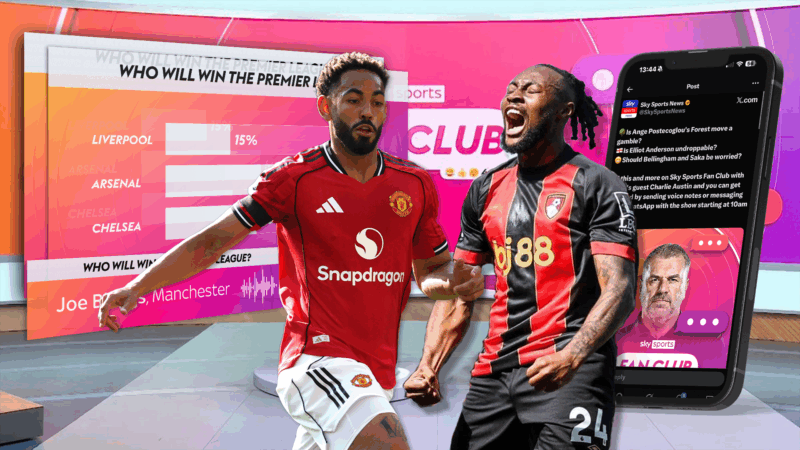
Platforms like Polymarket and Kalshi have built something genuinely interesting: real-money markets on live events, driven by crowd intelligence rather than expert opinion. We’ve been exploring how that data layer translates into a broadcast context. Not as a betting product, but as a live signal. What if a broadcaster could show, in real time, how market confidence is shifting during a match? What does a 20% swing in odds tell you that a scoreline doesn’t?
The final PoC pulls in markets which are shown on a live video stream via html graphics. We also introduced a basic voting mechanism allowing users to agree or disagree with the predictions which build stories – “the markets say X, our users disagree”

MCP Apps and AI-powered fan engagement tools
MCP Apps let you return interactive UI applications (data visualisations, forms, dashboards) that render directly in the LLM chat windows. We’ve been building apps for both Claude and ChatGPT, testing what becomes possible when AI has direct access to the kind of fan and content data we work with every day. The short version: the gap between “AI generating generic content” and “AI doing something genuinely useful inside a product” is a tooling problem, and MCP Apps is part of how that gets solved. For sports organisations, that means AI tools that can surface fan engagement data, personalise content recommendations, and surface monetisation opportunities directly inside the conversations fans are already having.
After loading the app we requested the next 6 fixtures for a team. After rendering these, the chatbots response was to ask if we wanted to predict the lineup for the next match or vote on a poll for the result as it understands the scope of our data and how to package it in a variety of interfaces within the chat window.
Player momentum tracking and fan attention signals
Momentum tracking is about what’s happening right now. A composite signal built from four live data streams: on-pitch performance, search trend velocity, public sentiment, and social conversation volume.
The score isn’t a single metric. It’s a weighted index that surfaces which players are accelerating in the public consciousness, not just on the scoresheet. A player putting in quietly effective performances might score well on performance data but low on search trends; a controversial decision in the 70th minute might spike social and sentiment signals before the match has even ended.
The real ambition is broader. The same four-signal framework applies anywhere public figures generate measurable attention: entertainment, politics, tech. Swap performance stats for box office rankings, search trends for Google Trends, sentiment for review aggregators, and social for platform conversation volume, and you have a momentum index for actors, politicians, or founders.
The connectors change. The model doesn’t.
What the Kitchen isn’t
It’s not a skunkworks. It’s not a place where ideas disappear for six months and come back as a PowerPoint. The whole model is built around short cycles, real builds, and honest outcomes. Some things will fail. That’s not a bug, it’s how you find the things that don’t.
The Kitchen is messy, exploratory, and deliberate. In that order.

FAQs
The Dizplai Kitchen is Dizplai’s internal R&D space for sports tech innovation. It’s where the product team explores early-stage concepts without waiting for client briefs or budget approval cycles. Every idea goes through a discovery process first: is there a real client need, and is there genuine market demand? The ones that pass move into active experimentation. The ones that don’t get dropped, which is how the process is supposed to work.
Current projects span three areas: prediction markets as a live broadcast data layer (showing real-time crowd intelligence signals during matches), MCP Apps that bring interactive fan engagement tools into AI chat interfaces, and a player momentum tracking index that combines on-pitch performance, search trend velocity, public sentiment, and social conversation volume into a single composite signal. Each project starts from a real industry problem.
The Kitchen is Dizplai’s proof-of-concept engine. When a concept clears the confidence threshold, meaning it demonstrably solves a real problem at scale, it gets handed to the wider team to develop and take to market. Clients and partners who want visibility into what’s being built can ask for that conversation directly.
Because the sports and broadcast industry moves slowly by design: long procurement cycles, conservative budgets, and low tolerance for failure. If a product team only builds for the next client conversation, it loses the ability to notice shifts in fan engagement behaviour, audience monetisation models, and technology before they’ve already happened. The Kitchen is how Dizplai stays ahead of that curve.
Yes. If you’re interested in seeing what’s being built, or if you have a challenge you think the Kitchen could explore, the conversation is always open.
And if you’re a client or a partner who wants a look inside, that conversation is always open.