

Fan Engagement > Podcasts > Everything You Need to Know About the ICONS Series in 40 Minutes | Chris Sice
Summary
- Why Athletes Beat Celebrities Every Time: The ICONS Series isn’t a hit and giggle celebrity golf day. Chris explains why using elite retired athletes creates a level of genuine competitive intrigue that celebrities simply can’t replicate. Hearing John Terry admit first tee nerves feel like a Champions League penalty is the kind of moment no scripted format can manufacture. But does it only work because these athletes actually love golf?
- The Challenger Brand Distribution Playbook: Sky Sports provides the linear legitimacy, but 60% of ICONS’ views come through its 25 publisher partnerships and creator network. Chris breaks down why Facebook delivered numbers far higher than anticipated, how LiveScore’s involvement marked a genuine new frontier for live sports distribution, and why loosening the reins on creator partners is still one of the most uncomfortable conversations in sports media. Are rights holders ready to fully let go?
- Why In-House Production Changes Everything: This year ICONS bolstered its internal team with Joe Bass from I’m a Celebrity and Soccer Aid, and Tim Lacy from IMG Golf. Chris explains why bringing golf expertise, entertainment instinct and social thinking into the same room rather than treating digital as an afterthought is what separates great challenger sports content from average broadcast coverage. So why are so many organisations still parking their social teams outside the room?
- The 50% Engagement Rate Nobody Expected: The ICONS Interaction Hub recorded 22,000 visitors with a 49.8% click through rate during Bangkok, and Day 2 singles delivered an average viewing time of 36 minutes. Chris and Ed break down why audience participation only works when it enhances the editorial rather than interrupting it, and why the difference between a bolt on and a baked in feature is everything. Is the second screen actually where the remote control now lives?
- Content That Lives Beyond the Event: A single drone shoot involving all players and presenters became a content series in its own right. Chris explains why the most valuable thing ICONS is building isn’t the tournament, it’s the always-on content architecture that keeps audiences engaged between tentpole events. From evergreen formats to pre-event flares, how do you stop a challenger sports brand becoming a one night stand?
- The One Thing Sports Organisations Are Still Getting Wrong: Chris’s advice for the industry is blunt. Stop leaving the decisions to the people who have always made them. Getting social-first thinkers into the room at the creative stage rather than asking them to cut down a broadcast package afterwards is still the single biggest missed opportunity in sports content. The tone shift from commentating on sport to bringing the viewer onto the shoulder of the talent is closer than most organisations think. So what’s stopping them?
Transcription
Ed Abis (00:01.221)
Hello and welcome to the Attention Shift podcast. Today I’m joined by Chris Sice. Chris, how are doing?
Chris Sice (00:07.372)
Yeah, all good, all good, all good. Looking forward to chatting.
Ed Abis (00:10.565)
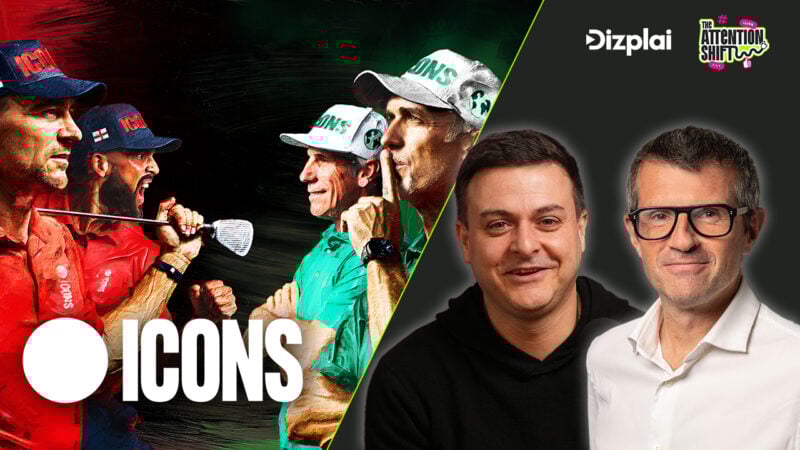
Me too. Chris, you’ve worked through some amazing projects down the years, but specifically here, we’re here to talk today about the Icon series and the most recent edition of that that was done out in Thailand. So, can you sum it up for me a little bit? What is the Icon series?
Chris Sice (00:29.166)
So Icon Series is a golf event that is played by non-golfers. It is played by professional athletes from different sports. And over weekends, you’ll have four sessions of golf and it is, you know, proper golf, proper competition, televised on Sky and the likes of Sky around the world, you know, four or 5,000 people a day. And…
Ed Abis (00:48.122)
Intense.
Chris Sice (00:58.932)
There’s been six or seven of these that have been done over last 10, 12 years. The last one we’ve just done in Bangkok was a football edition and you had the likes of Batis Duta, Zola, Gareth Bale facing off against an England side of John Terry, Theo Walcott, Joe Hart. So 12 players on each side, two golf captains. had Danny Willett and Thomas Bjorn as the golf captains.
leading them in a team match play event over the weekend.
Ed Abis (01:32.793)
Interesting, I guess as well, a little bit of the backstory about this. So the series itself didn’t start necessarily as a broadcast play, like this was an idea of the founder, Thomas Brooks, to see what would it be like if you move, I guess, elite athletes out of their comfort zone into a sport that they wouldn’t necessarily be associated with for fans. Is that sort of where his original idea came from?
Chris Sice (01:56.439)
Yeah, I think, you know, essentially presenting players in a different manner.
under different sort of competitive rules and seeing could they switch sports and win. I think there’s a level of intrigue that comes with that. It so happens that a hell of a lot of sports people, tennis players, F1 drivers, footballers, they love the golf. So put them in a different competitive environment where it’s their passion and they love it. And, you know, add proper.
competition around this and you’ve got the sort of ingredients for them to really want to be involved rather than this be a sort of paid affair where they’re turning up because they’re being paid. They do this because they love it and they’re hard of it.
Ed Abis (02:46.896)
Yeah, can, the experience certainly came across to me, like the intensity of the competition, but also how much they’re enjoying it. And I think what was interesting as well is, in the world now where, you we hear a lot of talk about creators and celebrities doing these kinds of things, why was the decision made to go and pick athletes to go and do this rather than, I guess, look, it’s vogue now, right, to use creators or celebrities, why go and pick athletes to get them out of the comfort zone?
Chris Sice (03:10.326)
I there’s a greater intrigue. mean, you see, you know, we’ve all grown up and we’ve seen celebrity golf over the years. You see some exhibition golf and, you know, you’ve seen Ronnie Korber, Piers Morgan, you see those sorts of things. Absolutely. you know, they’re great, but we use the phrase a little bit. It’s like actually icons. It’s not a hit and giggle.
Ed Abis (03:24.13)
Alice Cooper.
Chris Sice (03:33.398)
It isn’t just a fun event, this is proper competition. And it is genuinely interesting to see some of these elite sportsmen in a different environment. And it’s particularly humanising, actually, when you see some of these guys talk about first-tee nerves. Really, hearing John Terry say, this is a little bit like taking a penalty.
in a Champions League match and in meaning it. So actually, football you do it by muscle memory generally and then there’ll be occasions when it is just you.
Ed Abis (04:00.303)
Yeah.
Chris Sice (04:08.564)
everyone is watching and you need to deliver and I think actually they love those moments again. Particularly as the majority of people who play, they’re not everybody, the majority of people who play they’ve come to the end of their career so actually put them in a new competitive environment and they love it actually and it’s intriguing, it really is intriguing just to observe and see how they deal with those pressures and here
Ed Abis (04:28.986)
Yeah.
Chris Sice (04:38.082)
those moments of nerves, where they actually reveal it. They don’t hide it like you might in football. They reveal it and that is very relatable.
Ed Abis (04:43.044)
Yeah.
And interestingly for me, obviously, some of these players will have known each other and will have been teammates, but also probably rivals down there. Were there any, I guess this is a geek question, were there any rivals that are of over hung from past tackles or experiences that you’ve noticed?
Chris Sice (05:02.19)
I mean, it’s quite interesting hearing some of them actually. can remember John Terry last year, us asking him about Tottenham, and we talked about rivalries last year and almost every player, they kind of fended away the question. As football is a skill to do so. John Terry, he absolutely didn’t. He I hate Tottenham.
Ed Abis (05:16.624)
Yeah.
Chris Sice (05:24.006)
He said, if I come up against Aragin it will mean more. I loved it, it was brilliant. There’s a certain playfulness that comes with that. But actually some of the rivalries bring up other storylines. They bring up a sense of you wanting to see if…
Ed Abis (05:32.58)
Yes.
Chris Sice (05:43.01)
you know, Inselbeat, Patastuta, know, this sort of great England, Argentina rivalry or other storylines, know, Arsenal, Tottenham storylines that come up. I think viewers, can engage in a different way and, and it’s brilliant hearing players talk quite freely in a way they might not have done many years ago.
Ed Abis (06:03.076)
Yeah, I think that the competitive edge of these athletes, also like, because you used to seeing them playing for like, like, got Battistute is probably one of my heroes, right, and Zola certainly, being from sort of the same island that I was born in, Sardinia, even though I don’t sound like it, like to see them actually talk, you know, because you used to see them playing in a football shirt for the clubs they played for, having done what they’ve done and, you know, Battistute with his long hair back in the day, and it was only later on his career where he had the short hair, but to then hear him talk about his experiences and in that environment, he…
It is, it’s quite disarming when you see them like that.
Chris Sice (06:36.011)
Yeah, I think you see and feel something different that you haven’t come across before. You know, we noticed it. Yes, I’ve been involved the last couple of editions and I noticed it last year. We asked a few more football questions and we didn’t necessarily get fascinating answers. Actually, when you went to the in a slightly different way into what is a passion centre for them, they open up in a different way. And that’s
Ed Abis (06:42.117)
Yeah.
Ed Abis (07:01.2)
Yeah.
Chris Sice (07:04.177)
I if you’re getting something that feels different, you’re able to see a different side of these personalities, that’s interesting. And people lean in that much more if you’re able to get that. And I think there’s something about them playing golf and then revealing things that is much more engaging for an audience.
Ed Abis (07:25.444)
I often say these kind of experiences, it’s the stories behind the stories that really get people, I think to resonate with them and to connect with them. From, I guess, like you said, you’ve been doing this six or seven years now and you’ve done this with different sportsmen and women from different backgrounds. What have you, I guess, what have you started to learn over those period of time? What have you started to refine with the different formats that you’ve used for this?
Chris Sice (07:49.614)
What have we learned over the time? I think at the heart of it you’ve got to get the golf competition right first of all. The last edition we had was a little unbalanced. The team were much better, brought in much better players this time. If at the heart of it your sport is aligned and the truth is whatever, I’ll talk a lot about content, we’ll talk a lot about audience participation, there’s many things you add into those formats.
the heart of it you want great sport. So I think the key thing is get those sides really balanced and fortunately we did this time that gives you the foundations where there’s just incredible winners, losers, know structure for storytelling that sport you know delivers in an incredible way you know and then I think we’ve started to layer in
format points or other storytelling means that bring this to life, I think really importantly, bring a different audience in. And that’s something that we worked on quite a lot as we’re a challenger brand. So you need to work harder to build that brand, to create storylines in the buildup to this that draw an audience in to even be curious.
That’s the starting point that you need to do before you even get to the event Otherwise, you’re just awash with so much noise out there So there’s a lot more work that we’ve done I would say particularly in building storylines and ways to film With the talent and the buildup before you even get to the event that gives you a chance to bring that event to life in the way you’d like
Ed Abis (09:30.756)
Yeah, look, I’m a sucker for things that look nice as well. And I think the visual storytelling that you’ve done with it, the way it’s designed, the whole look and feel of the brand and the way that you build up that storytelling before, throughout and afterwards. I’ve not seen many challenger sports brands anywhere in the world that are doing it in the way you’re doing it. It looks top end premium.
but there’s still a connection, like said, to the sports individuals who are part of it as well. I think it’s very unique how you’ve done it and it can’t help but draw the eye when you see it in amongst all the content formats.
Chris Sice (10:08.685)
That’s great to hear. There’s a chance you have him, I think if you build the right team around this, but think most importantly right at the heart of it, the players, the real storytellers, if they love it, if their eyes light up as you’re doing it, you’ve got a greater chance of creating great content and I think it in truth it really stems from them being open.
to do this and allowing us possibly more time than you might get on other events that I’ve worked on in the past. They give us a lot more time because they love it. And there’s a value exchange actually. They look pretty good at the back of this as well.
Ed Abis (10:45.839)
Yeah, yeah.
Ed Abis (10:51.727)
Absolutely. I’m sure people watching this and listening to this are going to be sort of curious around your distribution model, right? Because you talked earlier about like, you you distribute via the legacy media companies like the skies of this world. And that’s really, really important because that reaches the demographic. But also you do a lot of distribution through different social media and video platforms as well. I guess. the question for me is, like, look, it’s always going to be a challenge, right? Because you’re a challenger sports brand. But what kind of opportunity does that does that actually give you?
that there is no set way that you would distribute this because it’s a new format essentially.
Chris Sice (11:27.371)
Yeah, I mean it’s a balance for us. TV is really important. TV is very important for our partners. It’s important for the high CPMs that also come with TV. And there’s a certain amount of legitimacy as you’re building as a challenger brand where even for players, they love knowing they’re going out on Sky or Canal Plus. But I think around that, particularly in us trying to build for, you know, as I described, the modern fan.
being able to work with YouTube and offer many more ways in and audience participation methods, I think is really key. And the distribution around that is critical as you’re building awareness, as you’re building reach. So I think there was 25 publisher partnerships that we had. I think we had 10, 12 creator watch alongs. We had seven or eight creators there.
Their involvement is crucial in expanding reach in a very different way, hitting different audiences. So the combination for me really helps you cut through in a way that’s credible. And I think it’s a really exciting area in navigating this new ground. But yeah, we’re really pleased with the results.
Ed Abis (12:48.345)
No, look, it is challenging, right? you could, it’s clear you could throw it out there in so many different places, but you want to get the right balance. I know that obviously we play a small part in terms of helping you with around that distribution side and the driving that, getting the audience to interact with it as well in a way that TV doesn’t do it in the same kind of fashion. And we had some success this year. We had a few different partners, right, with people like Life Score coming on board and actually taking the feed, which is toe in the water for them because they’ve not really done anything like this before.
And so it’s interesting that they’re starting to see the power of this, because normally people would expect to see that on YouTube, but Facebook started to play a role again in terms of being an area where live can be distributed, because for a few years it kind of went away, but it seems to be starting to rear its head again and sort of put its hand up and say, no, this is a viable alternative as well now for distribution.
Chris Sice (13:39.021)
Yeah, I mean, think, you know, with our numbers, Facebook was surprisingly high. I think there’s, you know, there’s a lot of us in the UK might have gone through that period of having a certain amount of interest and then dropping off, you know, for certain of us. In Asia, huge. And actually some of the partnerships that we then built delivered big numbers. And that was maybe 20 % of our numbers.
So, higher than I might have anticipated months ago, but yeah, really really important partner.
Ed Abis (14:12.559)
And how do you balance, I guess, protecting the brand and distributing through these different formats? Because ultimately you’ve got different partners, right? And they’ve got different wants and needs in different territories. Like, God, how is that balanced, I guess?
Chris Sice (14:26.762)
I mean we’re learning, you know, to be transparent. Last year we did some creator watch-alongs last year. There were some people suggested and I said maybe not. Maybe not this time because…
You were learning we were putting our toes in the water and I really didn’t need some people to then be dissing what they were watching. It wasn’t the right time for us. This year we did double the number of creator watch alongs. But I think you also learn to trust the certain partners you work with, get it. You know, who more mature, you work with DR Sports or something like that. Brilliant partner.
you know, completely understand what we’re trying to do, tonally understand how to work and you create a real partnership and they know their community and actually giving them the ability with their own tone of voice to add to it. We only build a sort of trust relationship that they got with their audiences that bring more people in and you know, I think.
I it’s a really important area with rights holders being comfortable, being slightly uncomfortable as they loosen the reins of who they work with. I think that will be a topic over the next few years to observe how you can do more.
Ed Abis (15:44.281)
Yeah.
Chris Sice (15:48.565)
with creators but with fans actually. And I think you need to put your toe in the water and try these things and see the value that can come and navigate a few areas that you learn may not be exactly as you wish but if you don’t do it you’re never going to learn.
Ed Abis (16:05.518)
suppose as the saying goes, with great power comes great responsibility. So if you’re going to be critical on something, if you’re the one who’s been given access to that, like be constructive at the very least. don’t be, you don’t have to, you can say you don’t like something without being abusive about it, which look, fans can sometimes, the emotions can run high and they can go a little bit outside of the lines. And we all understand that because we’re all fans of something.
But I think when you’re getting access to something like that, I think it’s important as well to be, again, constructive, liquidable, respectful. If you’re to critique, critique, but there’s got to be boundaries because that doesn’t help anyone.
Chris Sice (16:45.748)
Yeah, I think there’s got to be an understanding as well. Even somebody said to me early, look at our bail billard. You know, we did a sort of match up and, you know, package that up for YouTube and they said, actually look at the comments below.
and when somebody says look at the comments, I take a deep breath, god here we go, actually comments 90%, 80 % actually really positive, you can learn from so frequently you have to go in and just be comfortable with the sort of stuff that does get provoked online, particularly when you’re dealing with something as partisan as football.
Ed Abis (17:03.734)
Yeah
Chris Sice (17:24.604)
you’d expect the majority to be either slightly out there or possibly negative, whether fair or not. So you have to take some of that with a pinch of salt.
Ed Abis (17:35.705)
So this year was interesting as well because you bolstered the internal team that was working on this as well. you brought Joe Bassin, who’s got experience with Armyslep and Soccer Aid, and Tim Lacey from IMG Golf. And I Tim’s been there for a long, long time, right? And you can see the quality of the production. And look, he was good last year, but he went to another level. How does that feel to be able to bring those kind of people into the mix on this? And what do think it brings you in terms of the output?
Chris Sice (18:04.556)
Yeah, I mean, it’s brilliant. Both of those people are really talented and they bring a real level of expertise. There’s a sort of manner. What I talk about quite a lot is trying to create a one team mentality. You know, we’ve got golf expertise in the room. We’ve got entertainment expertise in the room. Also, we’ve got social in the room and they’re in the room.
You know, social or digital are parked outside. sat by the toilet and they’re seen as teenagers who will only hear things. That’s where I’ve grown up as well. So it’s fine. You can still operate from there, but you just got to be nimble. actually trying to bring people into the room. If you’ve got different levels of genuine real expertise and you combine that, then I think you can create a coherent product.
Ed Abis (18:33.134)
That’s normally where I am.
Chris Sice (18:55.399)
rather than digital and social add-ons which I think we’ve all probably been involved with over the years. But it really helps. Golf is complicated. That is a really complicated production, way more so than something like football. And if you go into the truck, the OB truck, and observe six or 12 golf matches going on at the same time.
Ed Abis (19:05.229)
Yes.
Chris Sice (19:18.803)
and work through how you present that at the same time while you’re bringing entertainment into this, there’s a level of creative friction that we are still learning and if there’s the right environment and what I really credit Tim, and Adrian our social guide with is actually blending together and sort of pushing and pulling and understanding it. might not be their area but actually listening and learning and then you’ve got a chance of creating a
new type of cocktail. It helps if you’ve got people who’ve been around but are still incredibly open-minded about how you might create something new. And I think creatively people love that. They like pushing boundaries from what they’ve done before. So that was my sense of how they came together.
Ed Abis (20:11.576)
And would you say that that’s an advantage for you being a challenger sports brand that you, you can mold the entertainment and the competition together. I like look similar, like I don’t know if you saw, last week, you know, formerly did the, the Evo sessions, right. And they brought arcade in. And again, you could see that similar. brought entertainment to that. There was competition about that. The creators really wanted to win and there was, there was a crash and, but there was an entertainment angle to it that you don’t see.
in most sports, that’s how you cross over from me onto the YouTubes and actually win an audience, not just put in a sport and then hoping for the best.
Chris Sice (20:50.633)
Yeah, I’d agree. think it’s fortunate if you start without the rules. I did something years ago called F1 Locks and I worked as part of official partnership with Formula One Management. It was that many years ago, with Bernie in the day. What was very good for me is I learned about rights the hard way. I felt beaten consistently as we were trying to do creative things, but I understood the rules.
and if you’re on the outside trying to change existing rules that’s quite hard.
This is part of the reason why I enjoy this role so much. If you’re right at the heart of the rights holder who’s open to say, okay, let’s push the boundaries. We don’t need to do that in the same way as other people do. I think creatively that allows you much greater license to do things differently. Sometimes you don’t get it right, but be able to push. It’s much harder with an existing legacy organization. So we’re pretty fortunate in that way.
Ed Abis (21:57.486)
what, what we really, mean, what, what, obviously what we sort of co-developed together, like we did the, you know, the interaction hub this year as well, where we, obviously we were driving visitors to ultimately engage with a number of things through it. And I think the thing that stood out to us, I think was that the close to 50 % of people who landed on the interaction hub actually engage with one of the interactive elements that helped to drive some of the decision making that was going on around the event as well. I don’t think it felt intrusive. I think it just felt part of it. And I think.
That’s a balance, right? I think we had about 22,000 people who did something, who were willingly taking part. And I think that’s probably one of the things that I guess we’re proudest of being involved with this, it felt baked in, didn’t feel like a bolt on.
Chris Sice (22:41.781)
Yeah, I I think that’s one thing I’d credit you guys with is what is the editorial suggestions you make enhance the product? They’re not novelty interruptions. I’ve seen over the years in doing different digital interactive pieces, sometimes being guilty of coming up with ideas. They sound great, actually they’re quite interruptive. They’re interruptive. And I think…
Ed Abis (23:05.281)
Yeah, me too. You absolutely go.
Chris Sice (23:11.525)
I your guys have been around the block that much and worked with different rights holders that there’s an understanding of editorial and actually putting pieces in that what I most want is I want to extend time spent viewing. I want people to lean forward, want them to emotionally engage with something. And golf can be a bit boring at times. You know, I like it, I can’t watch most golf for long.
So if there’s reasons to get me leaning forward and saying, voting for whether Bale or Bullard are going to win, or being part of a community where can post messages and see them up as a part of this, I’m much more likely to stick around. And that, I think it’s finding a way to enhance rather than interrupt that, for me is where, you guys have done a great job and I see it in watch times.
It was only earlier that I saw it actually. The singles on day two, session two is 36 minutes. That’s the average viewing time. The average viewing time. That’s massive. Coming from TV or looking, even after what we did last year, there’s some damn good reasons to stick with the sports.
that I would say if you’re watching general golf having people watch for an average of 36 minutes is wild. I think that’s rare. know and a lot of that are definitely put down to an audience who are much more engaged and have a reason to be.
Ed Abis (24:46.709)
Yeah, look, I think we’ve found you in that sense, right, that we have similar belief systems that the audiences want to feel like they can shape the content that they’re watching. They don’t just want to passively watch it. They want to somehow feel like they’re part of it in some way, shape or form. But like you say, it’s picking those moments because you do have natural blocks in golf where there isn’t a lot happening, but still that might be, Josh might be doing an interview with someone at that point. So that’s really, really important. We don’t want to interrupt that either.
So the windows are relatively small and it’s finding the right ones that then it ultimately flows, like you said, not that, we’re gonna go and do, go to social corner now, which is one of my pet hates when people do that, because it’s not the way to do this. It’s got to feel like if you’re having a WhatsApp conversation with a mate, like it’s the most normal thing in the world, because you just do it whilst you’re doing something else. It’s not like it feels like a bolt and you say to him, just one second, I just need to go and do it. It just happens and it has to work in the same kind of way. And I think that’s…
What I often find that with most things that I see where this happens, it feels like a bolt on. And that’s why it never works. And that’s why people never get the kind of traction with it. And then they wonder why.
Chris Sice (25:58.091)
Yeah, I mean, you know, I think so there’s a discipline in knowing where to use it and when, you know, I enjoyed last year the production company that we worked with, they were terribly good. I remember them saying before the event, you’re trying to do too much. You know, trying to run before you can walk. I respected them, you know, saying this golf is a little bit different. At the end of it, they said, can you introduce us to your guys, to you, because they could see
Ed Abis (26:15.095)
Yeah.
Chris Sice (26:26.344)
the value that it brought to the broadcast, that it was different, know, it was fresh. And, you know, I quite like the journey sometimes that people go on around that. You know, and also, you know, no doubt there’ll be some things that we tried, you know, that don’t work as well. And that’s great. You know, we can see that, can dispense with those things and identify the things that really do touch people.
Ed Abis (26:51.757)
We often say that when we have our little sort of conversations internally as well that I guess official sports data will tell, will give you the facts, but fan generated content will give you the feeling and marry the two things together and then you have context. And ultimately that’s all you’re trying to achieve. And I think more and more people are starting to see that now. Like I said, going back to that Evo session or so as well, like they did things in their own ways, right? And it wasn’t necessarily how I would do things, but.
that didn’t make it bad. Like it was good how they did it they did a different form of storytelling. I must admit, I watched some of it and yeah, I’ve not thought of doing it like that. Like, so, and it’s rare that I see stuff and think, I’ve not seen that. There was some genuine stuff in there where you think, yeah, there’s some takeaways there that is a different perspective. I wouldn’t have necessarily thought of myself.
Chris Sice (27:39.353)
Mm-hmm. Yeah.
Ed Abis (27:43.524)
So I guess the future of sports content, beyond the live window, look, you and your team, right, you are, I guess, there’s a pre and there’s a post, right, but the course of that weekend, yes, there’s the streams that are going live as the competition is happening, but there’s the storytelling that’s going on around it as well using different forms of VOD content. And I always sort of liken that to almost like you almost call that the live moment, because even though the event itself is happening within a certain window,
The window is much bigger than that. How do you think about almost like for something that happens in a relatively short window almost like an always on strategy, how do you think about how you extend that window to what is like the rest of the year, you’re kind of in off season right until the next thing. How would you use the content that’s been created to continue to maintain that audience?
Chris Sice (28:35.21)
I’m particularly interested in us creating formats. Creating formats and series that irrespective of events you can just keep running throughout the year. That I think makes a hell of a lot of sense for us as we will have a number of tentpole events that will be spikes that come. I think crucial for us to create formats that just keep the hum ticking along.
You know, as you build to events, there’s a lot of work that we did this year in saying, you know, I described it, we wanted to put a flare up in the sky. I think just as you hit event, it’s very easy to suddenly get noticed by the time you notice the event’s done. So actually during the week, you know, actually the task I put to the team is I said we had to have two bangers that you could put out that would really create a spike of interest.
Ed Abis (29:19.34)
Yeah.
Chris Sice (29:32.874)
You know, we did one thing that’s sort of drone shoot and, you know, we got all the players, all the presenters involved and actually we wondered whether we’d quite pull it off. But actually, you know, doing that, we’ve got everyone participating. You’ve got, I think all the players, CoLab, they all got involved. Your distribution is that much wider than suddenly you can put this flare up in the sky that you kind of need to do a couple of days before the event.
Ed Abis (29:38.812)
yeah.
Chris Sice (30:02.612)
and then carry your audience into events. So, you know, as I see it, there’s sort of evergreen content that you need throughout the year. And then there’s certain spikes that are incredibly important as you start to build that audience and try and keep them over a period of time. That is part of the overall plan rather than you can get lost having a sort of one night stand just if you think about it as one off events, I think.
Ed Abis (30:29.878)
I think that’s what legacy media, traditional media is often done, right? They’ll build towards one thing. And I think also that’s to a certain degree how advertising industry is also structured as well. Like one big push, campaign, it’s done. And once it’s live as well, very rare, I mean, he’s starting to change a bit now, but very rarely anyone touches it. It’s kind of like it’s out there now and it sort of lives and breathes, but there’s never, you don’t see any tweaking and changing to it or any reaction to what’s happening to fuel. I think what…
I mean, the specific thing of the drone thing that that pulled out its content plan on its own, right? The drone video, because I saw videos of how do we make that behind the scenes and like saying players share their perspectives as well. Like with a good plan that becomes like I said, monster in its own right. And it’s one thing. So you start doing 10, 12 of those, then you can see how you can build a window of really engaging content.
Chris Sice (31:19.795)
Yeah, think it’s, I think that even we’re learning as you do it, but actually you do an initiative like that. The array of different versions that come with, you know, the teas, the full thing, in particular, the behind the scenes, you know, the real sense of actually what was going on around that. People are fascinated by that at the moment and kind of I was as well, just looking in on it being filmed and
Seeing the players reactions, watching our drone guy who was sitting in a wheelchair with his mask on and we pushed him around the clubhouse, then at the end of that he replayed it and there was the production, was don’t know 10, 12 people looking over him in his wheelchair, looking at this screen and then I noticed there were four or five players trying to sort of find their way through.
In truth, wanted to say to Artie, just push back this Gareth Bale there, let him have a look. But actually, was insightful and fun and I wanted to see that out there as much as the real thing and the polished piece. So think thinking in breaking that down as a series in its own right is something that all rights holders want to do now and you can leverage even.
Ed Abis (32:21.42)
Yeah.
Chris Sice (32:44.903)
more value out of that if you can think about it and find the time to just create a plan around it. And I’d still say we’re learning, you know, as you’re doing it. But, you know, there’s a hell of a sort of life cycle that you can get from every content initiative you do.
Ed Abis (33:03.948)
And it’s part of doing those kinds of content initiatives as well where, because look, whenever I look at, I guess, European sportsmen and women who are not necessarily as versed in making this kind of content as our American cousins are, right? Because you can see some of the stuff that Kobe Bryant did down the years for Nike in like, you know, as a lecturer in a classroom and like, know, where Kobe’s almost, you remember some of those where Kobe’s almost like lecturing everyone. We don’t often get that with European sportsmen and women because they’re not used to the same kind of acting as it were.
So I always watch that whenever I see these kind of things, but they looked like they were genuinely invested in what it was and it felt real. It’s the thing I always look for.
Chris Sice (33:45.458)
Yeah, I mean, I’ve never seen, you know, I’ve never seen talent as invested as they are around this. I’ve I’ve never seen it. And that’s, you know, they enjoy it. There’s a certain amount where, you know, excuse me, you know, I’m very conscious about the amount of time we use. They’re there to play golf and there’s, you can ask for too much, but actually frequently around this on the whole, they want, they like, they really enjoy it.
Ed Abis (34:03.403)
Yeah.
Chris Sice (34:14.791)
They want to get involved and there’s an environment in which they’re looked after pretty well. It’s a pretty sweet environment. So giving a little more than you might do otherwise. Saying there might be something in the contract says you might do a couple of posts. All of that’s ignored. They post what they want. We give them the sort of things that they like and they’re like, yeah, great. Give it to us at the right time at the right place. I look great.
There’s more more involvement. think everyone talks about doing something authentic. If you have your talent at the heart of it, they like what they are doing, my god, that shines through. Then we’re in a really lucky position for this to be quite playful. The world’s your oyster in what you can create around this.
Ed Abis (35:06.252)
And you can see that as well. there’s a, I get the sense there’s a great deal of, you know, people are there to work. There’s a great deal of fun as well while they’re doing it. And that creates a great environment.
Chris Sice (35:15.689)
Yeah, there’s… I think there’s a general sense around the whole production, the whole event. Players like it, people around it. I mean, it worked pretty hard. mean, events are pretty hard work, but there’s a buzz that generally floats around where there’s less of an us and them, you know, not being able to touch the… the talent will be able to talk to them. Kind of everyone’s there as a part of it trying to create some magic. And…
Ed Abis (35:28.416)
Yeah.
Chris Sice (35:45.957)
At the end of it, it’s pretty euphoric. The players most importantly come out of it feeling good and trusting. There’s definitely a trust about the storytelling and cameras that are around that aren’t there to show them up, but make them look great. I think it helps everybody.
Ed Abis (36:04.757)
Absolutely.
So I guess, look, as a challenger sport, there’s always going to be challenges, right? Because it’s not an established format. But I guess there’s also probably a freedom to what you’re doing as well. So what is the one thing that if you could give advice to digital sports organizations that they’re missing when it comes to how to, I guess, engage with the modern fan in terms of how they consume content digitally, what advice would you give?
Chris Sice (36:33.487)
I think one of the areas is interesting is getting people into the room. It’s often easier to get the most experienced people in the room who’ve been doing TV forever. And I think getting more, I want to say kids in the room, getting smarter people who come out of it with a social first mentality and bringing a cocktail together that helps you shake the product. think that’s, for me, really key. if there’s one area that we’re
we’re still talking about is we still think there’s more work we need to do to change the tone of what we produce. And that’s quite intangible. It’s quite intangible moving from classic broadcast where you’re above what’s going on, commentating, looking in, to being a part of it and bringing the viewer with you on the shoulder of your talent. And I think…
Ed Abis (37:14.485)
Yeah.
Chris Sice (37:31.015)
that is still an exercise that we’re working through that I think creatively is fascinating. And I think you’re getting closer to creating some really fresh feeling content. There’s a certain amount of YouTube tone, but quality that can still come from broadcast. I think you need to experiment with different people in the room, but definitely don’t just leave the old guys to come up with how it should be done and then pass on.
that to social diversion what they’re doing.
Ed Abis (38:05.259)
think you’re right. It’s a co-creation exercise, right? They’ve got, like you said, they’ve got to be in the same room. And I know, similar to you, I’ve been in plenty of those environments where, like you said, certain people are sat outside the room. if they’re not part of it, then you cannot hope to reach all the different audiences that sit in lots of different places now. Because we live in a fragmented world. It’s just not possible. You’ve got to have all those people in the same room.
Chris Sice (38:32.851)
Yeah, for sure.
Ed Abis (38:34.827)
Chris, this has been fascinating. Obviously, I hear lot about this all the time, right, because we’ve been working with you now for a couple of years, but to be able to have this conversation with you and go through this and hear some of your experiences, it’s great. Obviously, I only see photos from my guys on the ground and the great fun that they’re having that I’m not having when you do these things. So it’s great to speak to you and get a bit more detail on it. So thank you so much for your time. I really appreciate it.
Chris Sice (38:58.813)
Yeah, my pleasure. My pleasure. Great to chat with you Ed.
Ed Abis (39:01.181)
You too, thank you. So thank you for joining us for this week’s episode of the Attention Shift. Don’t forget, I always get this wrong, to like, subscribe, and if you want to feature as a guest, give us a question or tell us how bad I’ve been interviewing. I’m hopefully getting better. You can email us at helloattentionshift.media. Goodbye and thanks for now.

- Tags: Brands & Agencies, Creators, Media Networks, Sports