

Summary
- The Platform Question That Changes Everything: It used to be simple, you made a TV show. Now the first question Buzz16 asks every client is which platform are we delivering for? Joe explains why that single shift has fundamentally changed how content is conceived, planned and produced. Are most producers even asking it yet?
- The Organic Share Test: Anyone can post their own content and tell you it’s brilliant. Joe’s real measure of whether something has landed is whether someone with no obligation to share it does anyway. So why are so many teams still optimising for metrics that don’t prove that?
- What YouTube Still Gets Wrong: The spontaneous point-and-shoot era is over. Joe argues that pre-production and planning is the most underrated skill in the industry, and the best creators are quietly adopting broadcast disciplines. But are creators willing to give up what made them different in the first place?
- The Metric That Actually Matters: Views and watch time are table stakes. Joe’s real measure of success is whether people with no obligation to share your content do it anyway. So why are so many teams still optimising for the wrong numbers?
- The Generalist Has Won: When asked what one skill producers must master, Joe’s answer is telling. You can’t master just one anymore. From strategy to platform awareness to shooting and editing, the modern producer looks remarkably like the solo creators who built YouTube from nothing. So is the specialist producer already obsolete?
- The Gap Is Closing Fast: Joe traces his career from making short-form digital highlights nobody took seriously in 2009 to running a company delivering for linear, YouTube and everything in between. Is the gap between broadcast and creator content almost gone entirely?
Transcription
Jo (00:03.374)
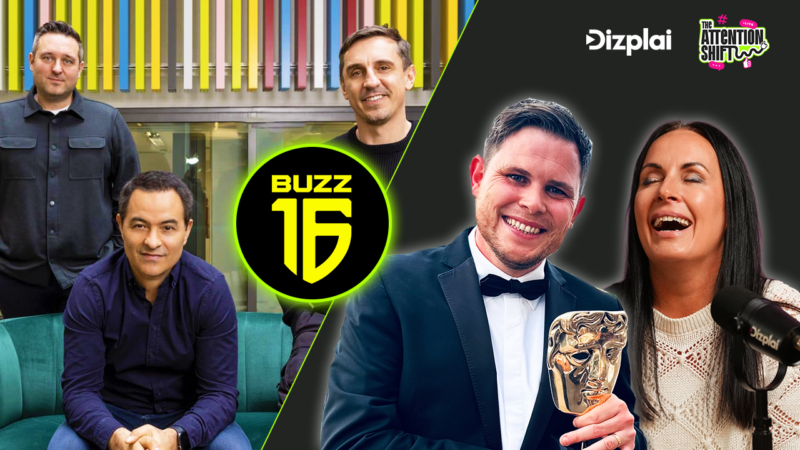
Hello and welcome to another episode of the Attention Shift podcast. And I’m flying solo today and that’s because I’ve got a guest. I’m delighted that we’ve got with us today, managing director of Buzz 16, Joe Bennett. Welcome Joe, how are you?
Joe (00:17.042)
I’m good, thank you. Thanks for me on. How are you?
Jo (00:19.118)
You’re most welcome. Now, we’re gonna get straight in, tell us, so tell us a little bit about Buzz16 and you, because you’ve worked across digital, traditional broadcast, now you’re running a company. So tell us a little bit about you, what you do, and how your role as a producer has changed over that last 10 years.
Joe (00:39.134)
Yeah, it’s been a busy, busy last 10, 15 years. So I got into the industry as a junior AP edit assistant back in the day. Actually, when I came into the industry was almost as digital content was starting to become more of a thing. So I actually joined a company called Perform back in 2009-ish, that has since obviously come on to become the zones of today.
So that was my first introduction into the industry in terms of sort of making short form digital highlights for web player content. So was sports bulletins, sports highlights, sports news stories. And then I batched, so I bizarrely started in sort of digital content, transitioned into going to work for input media as a assistant producer there, which was my first foray into broadcast, proper broadcast television and sort of
my grounding of a broadcast experience, became an assistant producer there, went on to work for Sunset and Vine at BT Sport, again in traditional broadcast. And then whilst I was working on the Premier League coverage there, an opportunity came up to actually shift into digital. And I went to work for the FA and worked with the England football teams, most notably the Lionesses for a long time, strong affiliation to women’s sport based on my time at the FA. But that was actually a very good time to, I guess, in terms of the
title of this podcast, Attention Shift. My background at that point was very solidly a traditional broadcast and delivering for BT and Linear. When I went to England, that was very much YouTube content. And that was the shift. It was just at the time when your content that was starting to do really well on YouTube. So your original sort of teammates type style content came out and that was my sort of grounding within digital content. And at that point I was a
Jo (02:15.085)
Mm.
Jo (02:32.621)
Yeah.
Joe (02:34.642)
I was shooting, editing, producing one man band, traveling around the world, creating content with the best footballers in England, which was obviously a great period. And then I left there to go to Chelsea very briefly as a senior producer, and then I joined Whisper. So I joined Whisper and they’re much smaller than they are now, the powerhouse that they are now in the industry. But my shift there was really a dynamic of juggling.
digital and broadcast. I went there as a multi-platform producer. So again, as this evolving role became, it was as everyone was realising that.
there wasn’t just linear, there wasn’t just digital. It was starting to become one and become more joined up. So that was my sort of original remit at Whisper was to bring those two together. And that was my oversight and progress progressed whilst I was at Whisper. And then I’ve been at Buzz now for 14, 15 months. So I joined that actually joined Buzz as head of content to oversee all of our digital non-live and live content. Again, from my background.
Jo (03:17.571)
Yes.
Jo (03:26.478)
Mm.
Joe (03:43.41)
within the industry, having worked across those three sectors. That was my remit when I came in. And then to the back end of last year, I’ve now stepped up to run the company. So I’m managing director at Buzz16, which is a different challenge. It’s no longer a producer type hat on and more business orientated, but it’s good fun.
Jo (03:46.968)
Mmm.
Jo (04:00.159)
Yeah. Well, yeah, we’ll definitely get into the running the business side of things in a bit because that’s another challenge in and of itself. But just sticking with the producer and the creative side, I mean, it’s interesting because there’s certain parallels with my own career. So I’m interested to know from you, you mentioned you started out making digital and social content. I remember when that was just the filler. It was the ancillary stuff.
You know, it was the stuff that happened over there and there was a little team that did it and nobody really took it that seriously. And here we are in 2026 where, as you said, you don’t just produce for one method of delivery anymore. You still have broadcasts, but social now is so much more important. Social first consumption. We know that YouTube is ostensibly the gateway, the doorway into fandom for a lot of sports, you know, for the under 35s particularly. What…
I mean, in a nutshell, how have you observed that shift over the course of your work in all of those companies and that trajectory that you’ve just explained? What’s been the overriding kind of observation that you’ve made in how audiences consume sports content?
Joe (05:15.742)
Yeah, probably haven’t gotten enough time to answer the question in terms of this podcast, have we? It’s a headlight. I think the biggest shift for me is actually the shift and how quick that shift is continuously, if that makes any sense in terms of we’ve seen people turn their nose up and look down on YouTube and social content, like you say, then it becomes the go-to destination. And then it’s almost now this balance of actually what’s the primary platform that we’re delivering for? Yes.
Jo (05:17.998)
Give us the headline.
Jo (05:29.646)
All
Joe (05:45.394)
the rights might live on linear originally, but actually a lot of the second screen experience or what we’re actually trying to cater for is the split audiences in terms of two at the same time. And that’s the shift. That’s the shift that’s the hardest thing, I think, for producers and content makers now. That’s the thing to satisfy and to make sure you’re speaking to both audiences in terms of second screen, but also the linear product at the same time. I think the consumption habit, obviously,
Jo (05:50.698)
Mm. Mm.
Jo (05:56.686)
Exactly, yeah.
Joe (06:14.773)
depending on the demographic, depending on the client we’re working with, there’s variations there of which platforms you target initially. And I think, again, that’s a big shift. It depends on now, it used to be you make a TV program or a linear program or a documentary. And now depending on which brand you’re working for, it’s actually which platform. One of the first questions we ask for is what’s your destination platform? What’s your target platform? And I guess that’s a big shift in consumption in terms of depending on who the client is and you have to have that awareness of
Jo (06:29.581)
Yeah, yeah.
Jo (06:36.92)
Yes.
Jo (06:40.685)
Yeah.
Joe (06:44.689)
what works for each channel.
Jo (06:44.782)
Yeah, I couldn’t agree more. It used to be that you were a specialist in making a TV program or like you were early in your career, you were a specialist in making social content that sat on a web page. Now, the decision as to how that content is going to be sliced and diced and distributed to what really what you’re talking about is fragmentation really
You’ve got to think about that as you’re making it, as you’re thinking about it, as you’re producing it. And that, I think, is the switch, isn’t it? As a producer, 15 years ago, you delivered a TV show, and that’s what you delivered. Now you’ve got to think about feeding a whole ecosystem. You’ve got highlights, you’ve got creators, you’ve got sponsors, you’ve got to think about how you surface stuff that’s going to work well for the algorithm. That’s a completely different skill set as a producer, and now you’re…
running a business that produces. So what skills matter more now do you think when you’re thinking about that than maybe what a producer skill set was 15 years ago?
Joe (07:52.542)
always torn and I actually say this to my team now in terms of like at heart I’m very much a creative person and that’s always that will always be a passion of mine regardless I don’t get to do so much of it anymore that’s still a massive passion of mine I think an underrated skill for a producer or someone in the industry now is actually and my team will laugh because I’m not the most organized person it’s the organizational side but also the planning so like the pre-production the pre-planning
And actually again, we’ll go onto it probably later on about shifts in how YouTube content is now created compared to TV content. It’s a lot more pre-planning is now in YouTube content than potentially when it first exploded and content creators came on and were making great content themselves. But actually now you see the best produced content. And the biggest skill set for me is that planning, that organization.
Jo (08:28.109)
Yeah.
Joe (08:46.917)
You have to have that awareness, as you said, of that ecosystem that you’re trying to feed. you can’t just be a producer now that turns up and does a shoot. You can’t be a producer that just oversees a project. You have to be a producer that is considering the wider strategy. You’ve got to wear many hats. You’ve got to work out actually, and again, probably a shift from what we spoke about a second ago is, it used to be this whole thing of you wouldn’t share the content. You’d go and make an interview with someone.
Jo (09:01.645)
Yes.
Joe (09:14.129)
you wouldn’t dare give the best bits of that interview away until it went on linear. And obviously now that shift over time is very much like, get the headline out, get the news line out. And again, the way content is cut now, you want the scroll stopping, the thumb stopping bit of the content at the top, the drop the headline at the top, which is complete reverse of how everything used to be. So long way around, long way around of answering your question. I think the, the organizational side and the strategy side is a, is a skill you need to have. You have to have an awareness of
Jo (09:19.512)
Yeah.
Jo (09:24.803)
Mm.
Jo (09:33.164)
It did, yeah.
Joe (09:43.897)
everything now you can’t just be a creative the creative the creative element is important but you can’t
Jo (09:49.231)
course it is, of course it is. But as you say, it’s different ways of being creative. Because how you’re creative for linear broadcast is different to how you’re creative for a TikTok or YouTube shorts or even YouTube content. Because we know that the consumption habits are different there. You’ve got to have that hook upfront on YouTube to stop the scroll, as you said. Whereas you don’t necessarily need to think about that quite so early if you’re thinking about linear. So…
Joe (09:58.512)
Absolutely.
Jo (10:16.332)
different consumption patterns. And I think you hit an important point. As a producer, you’ve got to be mindful of the different ways you articulate your creative in those spaces. And that’s a bit of a shift, isn’t it? So you’ve got to be aware of the habits and how content’s consumed across all those different platforms. And you’ve got to do that much earlier because otherwise you’ve got to then go and recreate it and that just gets expensive and costly in terms of time.
When you produce something then, let’s look at success metrics, because this is a very live conversation at the moment. How do you, not just measurement of success, and we talk about Bob and all of that, kind of the importance of views versus retention, but as a producer and as a creative producer, when you’ve produced something, what do you think? What tells you it worked? What’s the definition of success for you now?
with content.
Joe (11:13.349)
Yeah, it’s again, without sitting on the fence, right, in terms of there’s there’s many answers to that question in terms of depending on who we’re producing for and, and what that client is trying to deliver. So at Buzz, I very much describe us as a 360 company, we are a company that deliver for linear, we do deliver documentaries, we do deliver digital content. And actually, the success is different for all of those platforms, depending on who we’re delivering for, I guess.
Jo (11:28.579)
Yes.
Jo (11:32.236)
Hmm.
Jo (11:42.264)
course.
Joe (11:44.069)
I guess for me, know when something selfishly, I think something is successful when it’s been shared by people that are invested in the content, but or either the athletes or the people involved that have organic, if they organically share, we’re all very aware that people are paid to share posts and, and exactly. But if someone shares it organically, I think it’s brilliant. But also I think, and again, I know we potentially touch on it, but LinkedIn is such a powerful platform.
Jo (11:56.777)
Mm. Mm.
Yes, there’s a nice validation on that when it’s contained.
Joe (12:13.988)
and there’s so much content that’s surfaced on there. But the shift in terms of a lot of producers, a lot of people, a lot of companies, we do it the same, post their content to say, look at us, we’ve done this, it’s brilliant. And that’s fine. And that’s part of the game we all play. But actually, I actually see a measure of success is if you see other people in the industry, if you see people in the audience demographics sharing and commenting about your content organically rather than…
your own PR of it is a big success metric. Now again, that’s a bit of a vanity thing in terms of, obviously we look at KPIs that are associated to the content and watch time and retention, but for me, I think something’s landed if you can see that something surfaces naturally rather than you posting. Me telling you it’s brilliant is great for my content, right? I can tell you why my content’s brilliant all the time, but if you’re actually telling me or you’re telling someone else.
Jo (13:02.253)
Yes.
Joe (13:13.222)
Have you seen this piece of content from so-and-so? This is fantastic because of XYZ. That to me shows you’ve cut through.
Jo (13:14.647)
Yes.
Jo (13:19.404)
Yeah, yeah, no, I’d agree with that. think, you know, it’s, it feels like vanity, but actually it’s a good standard of if other people rate your work and to the point where they voluntarily share it, then that’s a good success metric. I would agree with that. You mentioned a little bit about success being success for those who you’re working for. And of course, when you’re…
you know, in that agency side, that is really what you’re there to do is deliver on the objectives of your clients. So, I mean, you’re producing for the BBC and the WSL, for example. How do you shift your creative instincts now? Because obviously you’re the boss of the company as well, but you’ve still got your creative instincts as a producer, as you said. How do you shift those when you step into like a broadcaster system?
Do you still, I mean, obviously you’ve got to listen to their needs, but how do you kind of push innovation as well, given that you’ve got now experience across a great many platforms?
Joe (14:18.01)
Yeah, I think the challenge when you’re trying to be creative on a linear broadcast is completely different to YouTube, right? In terms of, as we know with the linear live sport, especially every second counts. So we have short buildup times, we have half time where you have to get X, Y, Z trails away. You only have a limited off air time off the back. So every second counts. So the difference, I guess, within the linear production would be…
Jo (14:24.514)
and
Jo (14:30.328)
Mm.
Joe (14:46.278)
Unless you’re adding value to the story, you leave it. Whereas on YouTube creation, when we’re obviously founded the overlap and stick to football and those chats, obviously you can let them breathe. And there’s great fun and engagement actually in the silence sometimes. And that’s part of the creative, but actually the creative in our linear is very much, you have to approach storytelling differently. You’re still storytelling across a live game of football, but actually.
Jo (14:49.954)
Mm-mm.
Jo (15:03.874)
Yeah.
Joe (15:14.616)
it’s how you do that. So the creative can come from different elements, but in the editorial, you’re still teeing up the story at the start. You’re still then, you’re telling people what they’re going to watch and you want to inform them of things to look out for in that match that’s coming up. The commentators then carry on that story, that narrative. You pick it back up at half time and then you have the resolution and hopefully, hopefully if we’ve done our job correctly or the games panned out correctly, what we wrap up at full time.
closes that story that we teed up at the start. So the creative is obviously the editorial narrative is told over a different timeframe and different style to a YouTube video. But in terms of the creative that goes into the program from promos, from features, that shifted as well. We work very much in partnership with the BBC. So it’s a real collaborative effort. So we work with Amy Myveld’s team at the BBC and her content teams to make sure
any content gathering opportunity, whereas you used to go and just do a sit down interview for broadcast that would sit into a program and that would be it. The collaboration now and the creative that we put into it alongside Amy’s team is how does that story live past just those 90 minutes? Because yeah, it’s great that we might get 800,000, a million viewers for our WSL coverage for a top game, but actually
Jo (16:38.062)
Mm.
Joe (16:39.984)
that content opportunity with Leah Williamson, with Olivia Smith, whoever that may be, can live so much wider. And again, with the characters we’ve got in there with Alex Scott doing the interviews, the reach of the game and the objectives and the creative again comes back to what we said around satisfying all the platforms. So we work hard with Amy’s team. Amy’s team, so the content team at the BBC will do a large share of the features
Jo (16:51.543)
Amen.
Jo (17:00.535)
Yeah.
Joe (17:09.264)
themselves, but we’re involved in the creative and we’re involved in the discussions around would this work? What formats would work within that broadcast for your game, but actually also land on digital platforms. it’s that collaborative creative approach, but also met that creative approach. Everything we do has to live outside of that broadcast. And again, within the editorial.
Jo (17:10.091)
Mm-hmm.
Jo (17:18.542)
Mm.
Joe (17:36.75)
everything we do within the editorial, we have to think now, how could that work across Reddit? How could that work across the other digital programs? Can we be a bit more, can we shape the creative of the program to be more debate led rather than sometimes you get bogged down on the nuance, but there is obviously an objective to educate and inform audiences. But actually the creative side is, can we add these elements that we know this conversation lives outside of the linear broadcast?
Jo (17:43.33)
Yeah.
Jo (18:05.528)
Yeah, and it’s interesting, isn’t it? Because when you’re the WSL, for example, mean, working with the BBC is great because you’re on the BBC. But as you said, once you’re outside the bounds of that schedule, it’s very difficult to start growing engagement. so you…
you have to borrow from YouTube in terms of all of that other content, in terms of extending that engagement, expanding it. And it’s not just YouTube, you’re right, to call out Reddit or it’s TikTok. And now the BBC has to try and think more like that. And they are, and they’ve been very candid in saying, and actually, we’re not experts in that, so we need help from partners and we need to upskill our internal teams in knowing how to use that. With that in mind, I mean, it’s always…
been the case, well it is the case, that you’ve got YouTube creators now who over the last 10-15 years they’ve disintermediated that relationship with the audience in a sense they’ve cut out that broadcaster middleman and they’re much closer to audiences and they have that participatory relationship with them. Over here you’ve got broadcasters who still are the experts in telling stories
So we kind of got two ends of the spectrum, but they are moving together. So what in your view can broadcasters steal from YouTube and YouTube creators? What competencies can they say, we need to have a little bit more of that? But similarly, what are creators, what can they learn from more traditional producers and broadcasters? Because that’s the world that I come from and you come from. But we’re part of that kind of joining of the two sides together now.
Joe (19:50.809)
Yeah, absolutely. I do think, as you said, I do think that gap is getting smaller in terms of obviously, and we see that within consumption habits and how many people watch YouTube on TV as well now. I think in terms of…
Jo (19:55.406)
Mmm.
Joe (20:07.1)
What works, and the reason I say the gap is getting smaller, I think if you look at what works on YouTube and what works on linear TV, a lot of it’s formatted, right? A lot of audiences are creatures of habit. They like to know what they’re coming to watch. So if that’s a repeatable format on TV, but also on YouTube, which is why imitation is the best form of flattery. Everyone does very similar content and concepts, right, on YouTube. So I think from that side of the conversation,
gap is quite, it’s closer than we’ve thought, it’s closer than we thought in old think in terms of it’s very similar. What’s being produced on YouTube is very similar to TV, but just slightly different skews and production and potentially slightly more risky or more stunt based on, on YouTube compared to your formats, your entertainment formats on linear. What can creators and YouTube learn from the broadcasters? I think
Jo (20:48.6)
Yes.
Joe (21:05.485)
Again, back to what I said at the start, think a lot of, and the shift has happened already and is happening now, is that pre-production, that planning, and you’re seeing creators shift from doing a lot of UGC type style, or just point and shoot their own camera. Then now we’re seeing YouTubers go to production companies or set their own production companies up. And actually that brings another layer of expertise, but also in a crowded market.
Jo (21:13.678)
Right.
Yeah, kind of spontaneous stuff. Yeah.
Jo (21:24.428)
Hmm? Hmm.
Joe (21:33.497)
I think a lot of YouTubers are turning to be more high-end production. I mean, some of the content you see now produced is really good compared to what used to be lo-fi. And I know there’s always this debate between what’s authentic and what does it cut through better if it’s lo-fi, but actually production standards have gone up. And I think that’s been driven via TV people coming into YouTube to help these creators as well. In terms of what TV could learn from, linear could learn from YouTube.
Again, I think some of that shift has happened in terms of I think a lot of linear we used to be very guilty of holding on to the story and you build and there’s a slow build and it’s you have this story arc and I’ll probably get daggers from people saying that that’s a lost and forgotten trait that is going out of fashion because of people’s attention spans but it’s getting that story up.
and making and giving people a reason to carry on watching. we do that with our WSL coverage. Like if we’re coming on with a game, we need to tell people why they’re going to watch this game. There’s a reason why you’re going to stay and watch the rest of this 90 minutes, which is a long time for people to sit and watch. So I guess that’s something that’s something the TV or linear takes needs to take from YouTube. But also again, it’s hard because the market’s so crowded. Obviously the content we see that does well on YouTube is obviously longer discussions.
Jo (22:28.782)
Mm.
Jo (22:37.87)
Mm.
Jo (22:44.408)
Yeah.
Joe (22:58.757)
There’s not so long on linear slots. Also the stunt-based content, I guess, it depends on audiences, guess, your own go with that.
Jo (22:59.128)
Mm.
Jo (23:08.418)
Yeah, and it depends what their need state is at the time. Sometimes that catches an itch that you happen to feel at that particular moment. But I agree with you. think there’s a couple of things that you said there that I thought were really interesting. One.
I think you’re right, there’s kind of almost been a lost art of how you construct stories, but I think actually there’s now an acknowledgement that there is value in that and that should be guarded. And creators do want to learn that. And they do want to learn that from traditional media, which is great, because hopefully it will keep you and I in a job. But similarly, you said, you know, we…
It’s not just holding onto stories. We used to hold onto content. You mentioned it earlier on. And actually that used to be where the value was. But actually now, the value is not in just being exclusive and keeping hold of your content. Because if that means it’s only going out on one particular platform, the very real risk is that you’re anonymous because there’s a whole swathe of people who can’t and won’t access it there for various reasons. So now, actually you need to have everything everywhere all at once. But there is still value in that story and that crafting
narrative and that you know that’s been developed over 70 80 years you know is the reason that there’s a reason why you know producers and even broadcasters like BBC are so good at it so it’s it is bringing those both sides together as you said and I do think that that’s coming right let’s get on to your responsibilities now you’re now you’re in the MD’s chair
Joe (24:18.095)
Yep.
Jo (24:35.97)
and maybe creative producing is slightly less of your daily life for good or for bad. Tell me, what’s your learning curve been like since you became MD?
Joe (24:50.362)
I’m No, it’s been a really, it’s been a, it’s interesting. I’m just trying to work out the best way to phrase it in terms of, so I took over as MD in December last year and it’s been a very much a learning curve of how to be in a boardroom and how you then report the business and then a lot of the challenges that.
Jo (24:50.734)
I am.
Jo (25:13.838)
Yeah.
Joe (25:17.562)
creative’s fight of obviously around budgets and how are we going to be most creative and to be creative you want this, this and this. And now obviously my business hat now is that’s great. How can we be creative but still make money? we, how are we hitting targets? How am I reporting those numbers? That’s been a big side of it for me in terms of I’ve always been, whilst I’ve been creative, I would say one of my skillsets through my career has been sort of being a picture and more, and I’ve never said I’m
Jo (25:20.244)
Thank you.
Jo (25:27.246)
You
Jo (25:45.251)
Mm.
Joe (25:47.299)
I would never, I would always say I’m not the most creative person. I’ve got lots of ideas, but I’ve always surrounded myself with people that I always think you should, you need to surround yourself with people that are better than you as well. if there’s someone that’s a better creative than me, that’s no problem. But my skill came in, actually, that’s a really good creative. Could we shift it to be this and satisfy this platform? So I’ve always kind of had that bigger picture view. So I guess that transition into the role.
Jo (26:07.756)
Yes.
Joe (26:16.026)
was more natural in terms of I’ve always had this bigger picture plan and I really enjoy the strategy and business planning side of stuff. So how are we gonna go and target this vertical or should we shift and pivot over here? And I’m very much enjoy that side. The learning curve has been very quick in terms of.
you accountability, I guess, right? it now the bucks, the buck stops completely with you. So you could, you could get something wrong on a budget as a producer and it doesn’t, it doesn’t necessarily affect you personally. If, if I signed something off now that’s wrong or we’ve miscalculated something, I know that’s going to bite me in the bum in a big way very quickly. And I then have to report that to the, to the business. So yeah, I guess, I guess that shift of
Jo (26:59.34)
Yeah.
Joe (27:07.748)
balancing creative, but also how can you be resourceful? How can you be efficient is the learning curve. But yeah, the boardroom definitely is the main thing.
Jo (27:12.334)
Hmm.
Jo (27:16.142)
Yeah, it’s interesting, isn’t it? As a producer, you kind of moan about restrictions and constraints that are placed on you by those in the board, and now you’re the other side of the fence.
Joe (27:24.378)
Yeah, absolutely. No, I know. I’d say my team will laugh because I always say I’m a creative and then I’m like, but can you just do it this way? Or can we do it this way to save some money? Is there a more efficient way or have we looked at it? And yeah, I guess as a producer, you just want to you just want to go and produce the best content, don’t you? And I feel sometimes you’re not bringing people back in because you’re always delivering for your clients and you want to deliver the most creative thing. It’s just, yeah, I feel like a nagging.
nagging parents sometimes, but there you go.
Jo (27:53.615)
That’s similar to how I feel these days with the, you know, teenage boys. I’m like, no, now I’m doing the things that I used to moan about when I was a teenager with my parents and now I’m doing it. It’s similar dynamics.
Joe (28:01.498)
Yeah.
Joe (28:10.821)
I mean, sometimes I do think it’s easier to rein my eight-year-old in than some of my creatives, but it’s a good challenge.
Jo (28:17.806)
Right, just before we wrap up, I’ve got a couple of questions, kind of quick fire questions. So yeah, give us your gut response if you’re able. So if one platform vanished tomorrow, whether it’s broadcast or whether it’s social or whether it’s YouTube, which do you think would, which loss would be felt most?
Joe (28:40.154)
Oh, we felt most I would say YouTube if that went. Do you want me to give a reason why on these? Just put that. Was it just to go through?
Jo (28:46.531)
I mean, can do, I mean, from either from a personal point of view or just from a market point of view, why do you think we’d feel the loss of…
Joe (28:52.698)
Yeah, so I think YouTube would be the biggest loss if one disappeared. I think the shift in consumption for that platform and the reach and just the way everyone is now habitually viewing YouTube, think, and even from a branding and commercial point of view as well, I think it would be a massive hit.
Jo (29:12.322)
Yeah, no, I agree. I cannot imagine a place where YouTube doesn’t exist, quite frankly. Right, and last but not least, and it’s been a theme actually, but see if you can articulate it in one or two words. Name one skill that producers must master in the next few years. We’ve spoken about how it’s changed as a job. What do you think is that one skill that a new producer or a relatively new producer into the industry needs to master?
Joe (29:45.402)
The reason I’m stumbling on it is I don’t think you can be a producer and master one skill. think you have to be in the modern, it used to be, I’m sorry, this isn’t quick fire. I always used to say to people, you needed to be multi-skilled. You couldn’t just be a producer. And this was from 2009 onwards. You couldn’t just be a producer anymore. You had to have, and you had to be able to edit. You had to be able to shoot if you wanna go far.
Jo (29:52.462)
Well, there you go, there’s the answer.
Jo (30:07.96)
No.
Jo (30:13.091)
Yes.
Joe (30:14.157)
But now that’s evolved even more, right? You need to be able to, like we said, you need to have that strategy. I think you have to have an awareness of consumption. You have to have an awareness of what works on what platforms and how you go onto a shoot. How do you carve that up? But actually just getting five pieces of content isn’t good enough. You need to make sure they’re five pieces of content for the right platform. So yeah, the long winded way, I don’t think you can be master one. I don’t think you can master one thing to be.
Jo (30:28.846)
Mm.
Jo (30:34.062)
Mm.
Jo (30:37.74)
No, I think you’re right. It almost comes down to being a generalist, doesn’t it? And for a long time, I mean, even all the way through school, we were taught that you specialize in something. But actually, when we look at creators and what creators were able to do when they were started creating in the kind of mid 2010s or early 2010s is like you’re saying, they were self shooting, they were producing, they were directing, they were editing, they were mastering.
the vagaries of YouTube, they were analysts, they were figuring out how to pivot their content if it wasn’t working. And I often say, you when I was working at the BBC, all of those competencies were in separate people and often in separate departments. Yet creators came along and they were all smushed into one person. And actually, you’re right, I think it comes down to that.
you’ve got to wear a great many hats and whether that means that you’re a generalist or there’s another term that I can’t quite put my finger on. But I think you’re right. I think that is the skill that producers must master, which is a great spot to round up. Thank you. I’ve really enjoyed this conversation. It’s been, no, really, really enlightening. Thank you very much, Joe Bennett of Buzz16 for joining us today. And if you like this, if you enjoyed this chat, let us know, drop a like or a share.
Joe (31:42.293)
Thank you for having me on.
Jo (31:54.827)
and subscribe and if you want to get involved or even kind of give us some feedback on today’s episode you can email us at hello at attention shift dot media. Thanks Joe have a great day.
Joe (32:07.341)
No, nice one, you too.
- Tags: Brands & Agencies, Creators, Media Networks, Sports