

Fan Engagement > Podcasts > Reacting to Jameela Jamil’s VIRAL Clip, & Is the Second Screen “Dumbing Down” Content?
Summary
- Is “second screen viewing” killing high-end drama? Why are major studios instructing writers to “dumb down” plots for audiences glued to their phones, and is this actually a fatal mistake?
- The myth of the shrinking attention span: Are audiences really losing the ability to focus, or have “interest spans” simply contracted in a world of infinite content choice?
- From distraction to enhancement: How can sports and entertainment brands stop fearing the phone and start using it to deepen the narrative through real-time data, community, and commerce?
- Legacy media vs. the Creator Economy: Why are traditional broadcasters using the second screen as an excuse for poor engagement while YouTubers master the art of the multi-platform ecosystem?
- The debate: Is 5 minutes of undivided focus actually more valuable to a brand than 30 minutes of semi-distracted multitasking?
- Are you ready for “vertical drama”? Why should smart producers be filming companion content for mobile simultaneously with their main broadcast to capture the total audience?
Transcription
Hello and welcome to this week’s edition of the Attention Shift podcast.
Before we get into the pod, we need to talk about how the fan landscape is changing.
According to the Financial Times, time spent on social media peaked back in 2022
and has been falling ever since.
But if social is in decline, how are you going to stay connected with your fans?
That’s exactly why at Display, we launched the Anonymous Fan Index.
We brought together the leaders of sports business
to identify the biggest gaps in fan understanding
and a clear path for ensuring you stay connected to your audience.
Welcome to the Attention Shift, a podcast where sports media
gets debated like a VAR decision, passionately,
chaotically, and with none of us fully agreeing on the outcome, right?
Welcome back to another episode of the Attention Shift podcast.
I’m Jo Redfern. I’m Lee Ratbun. I’m Ed Abis.
And today we’re doing something a little bit different
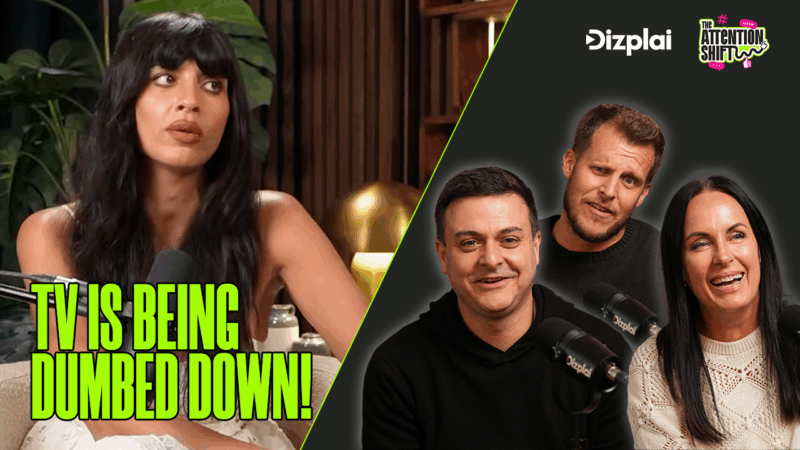
because we all watched a clip of Jamila Jamil recently
on Ramesh Ranganathan’s show, talking about second screens.
And it sparked a heated debate.
So, first of all, we’re going to play the clip.
I don’t know if you’re aware of this, but there’s something called
second screen viewing, right?
So it’s a directive that’s being handed out by big studios to filmmakers.
Please, this sounds like what I’m really hoping it isn’t.
It is exactly what you probably think.
This is something that stands out, which is which means that
you have to acknowledge that people are on their phones
the whole time they’re watching telly.
So you have to simplify the plot so that they be able to follow along
while they’re browsing on their phone.
So that’s why you’ll notice now in random like in TV shows,
even with good actors, they’re saying really obvious things
about what’s happening.
They’re laying out the entire plot line and all of their emotions
and motivations, like the language has become really bait and on the nose.
And that’s because they’re being told the writers
that they have to write in a way that someone can carry on
with doom scrolling or shopping online while following it in the background.
So nothing can be too complex.
Nothing can be too high end.
It has to be like we are we are purposefully dumbing down
content, and that is leading to a less nuanced,
less interesting, less thoughtful society.
OK, I’m going to kick off.
Did you know there’s something called second screen viewing?
Who knew?
Second screen.
Who ever want to work in that?
OK. Initial initial responses to that, because we we’ve got lots to say about this.
What about you?
Well, for fuck’s sake, as I said, I mean, the idea that we have to
dumb down the actual content because someone is on their phone,
like they’re on the phone anyway.
I don’t understand the mindset of that.
And ultimately it makes for far worse content,
which makes you be less interested in watching that actual content.
It’s the opposite effect.
I completely agree.
It’s like for years you’ve had people in the house that go off
and make a cup of tea while still trying to listen to what’s happened
in Happy Valley, or you’ve got the kids kicking off or you’re cooking their dinner.
I mean, do they think that there’s not been distractions
to watching TV for the last 30 years?
Or reading about why they got the TV on in the background.
People like people have done that kind of stuff before.
It’s not like suddenly because the the telephones there that they’re doing
something should still get distracted by.
You’ll be having a conversation with a person you’re watching it with as well.
I’m amazed that this is what commissioners in
in legacy media have realised this is the solution to short clips on social.
It’s really not a solution, is it?
Come on, Lee, I know you’ve got something to say.
I was going to say, I would argue that my wife still would ask me
what the plot is going on.
Even with all of that side-pistons.
She’ll kill me for saying that.
I’m sure I had the other day, what’s going on with this?
But she’s got more important things to think about.
She’s got games to be playing on her phone.
Yeah, much more engaging.
I mean, it’s just it’s crazy.
But I don’t think it’s I think it’s not just a movie and films problem.
It’s a sports problem that we are also trying to.
We have these general opinions of attention spans and, you know,
Gen Z only want highlights or people only want to watch this type of content.
OK, and it’s let’s let’s dive into that,
because that’s one of my favourite soapboxes to climb on.
But I mean, we’ve said it a gazillion times.
Attention spans are not shorter.
What’s happened is that interest spans have contracted
because when we were kids, there wasn’t much content.
So there was plenty of attention to go around.
And now that’s flipped.
Everyone remembers 20 million people watching Snooker.
Exactly.
But now we’ve got the situations flipped where content is almost infinite.
Therefore, there’s not much attention to go around.
Oh, there is, but it’s become scarce.
That means we’re much more selective about the kind of content
that we give our attention to.
This feels like a bit of a convenient get out to me.
I feel like a get out clause.
And I feel like this is one this is commission is going.
Oh, well, it’s it reads is really patronising to me.
I’ve commissioned some research.
So I know this is what I need to do.
So I can’t lose my job because ultimately I’m following the research.
Yeah. And but it smacks us patronising
because it assumes that people are getting dumber.
No, they’re not.
They’re just being much more discerning with where they spend their attention.
That’s on you, not on your audience.
But also it’s it’s it’s basically done
to kind of shore up what they do, isn’t it?
It’s to shore up TV.
What Jamila Jamil was talking about is a way to shore up TV,
not figure out how you might then articulate your stories
and your content across those both both of those screens.
You’re assuming the second screen is being used in a way
that is not compatible with the story you’re trying to tell.
Well, what if it was?
Yeah. Well, yeah, I was going to say, like it’s, you know,
it always assumes that, you know, Gen Z only want highlights,
but, you know, they’re quite happily binged at Netflix over a weekend,
you know, spend hours and discord.
And, you know, everyone seems to be going to or sport,
particularly is trying to go down this tick tock style.
Well, let’s just copy what tick tock does, you know,
making things snackable when it’s actually noise.
What the reason tick tock or short videos work is because they’re engaging.
They tell a story, they have an emotional reaction,
but they do it in a very short window.
They cover all the things that you should be trying to do
as sport or as film or whatever.
But that’s not to say that you want to do that all the time.
No, I mean, we’ve you.
There’s a reason that three hour podcasts are doing really, really well.
People do like deep dives into things and young people particularly.
They’ve they’ll have watch lists that are eight, nine hours long.
If they’re really into a subject, they want to go in
and they want to swim around and they want to absorb everything around it.
That is incompatible with this.
Oh, young people only want highlights.
Rubbish. And it is rubbish.
It’s claptrap.
I’ve had I’ve had a similar conversation with like Tony Passer,
the founder of Goalhanger about the rest is history podcast,
biggest history podcast in the world.
And and actually the demograph that listens the most is 18 to 34.
And I think they listen on you.
He’ll be able to correct me on this something like 30 on minutes.
They’ll listen to a podcast for now.
If they weren’t interested, they wouldn’t listen to it.
So this idea of of, you know, younger people don’t have attention spans.
He’s quite frankly ridiculous.
And this going back to what Jamila Jamil was saying
about TV writers having to signpost this kind of constant exposition.
I’m doing this. I’m going over here.
I mean, that gets boring really, really quickly,
even looking at some of the comments on that post.
People were like saying, yeah, and that makes me want to turn off.
So hang on.
She’s purporting it as a solution because people are second screening.
Yet one of the first comments is that makes me want to turn off.
That tells me that that’s not a solution at all.
But also you’re going to be replaced by AI even easier.
If you’re just going to signpost what you’re doing all the time,
then you can do that for you.
It’s literally what we used to do in kids TV.
That’s how you construct kids TV, particularly if.
That’s fine for younger.
Exactly. Oh, I think in preschool.
Yeah, that is literally how you would set up a preschool show,
particularly if you were educating them,
tell them that you’re going to teach them something, teach them
and then tell them what you’ve taught them.
I mean, that’s almost what she’s saying.
That’s history, isn’t it?
That’s not going to work for a 30 something person
who’s like watching TV of an evening.
So I just I can’t bring myself to agree with it.
I think it’s a massive misdirection.
And somebody somewhere has read the wrong piece of research
and is now changing how TV is being constructed off the back of it
when there’s a much smarter way to do it.
How would you use second screen or how do you use second screen?
And where do you think it might be better?
Or how do you think it might be better used?
I think he’s context, right?
I think some shows have a, you know, we work with
I’m slow to get me out with the after show that we do
where the viewers can send in voice notes of questions and observations.
That’s a great use of second screen.
That makes sense for the context of that particular show.
And actually, and it’s been great work with them the last couple of years
because they realized actually a voice note rather than just a text message.
Yes. Actually gives emotion, the delivery of like
so they get fans sending like jokes.
It just brings the whole thing alive.
And I think also it gives a connectivity to the guests as well.
I think you as an audience, make me feel like you’re part of that.
I think it’s probably the closest thing I’ve seen to how a YouTuber
streams and connects with their audience, where everyone feels like
they’re part of it on TV.
And it’s been so, so simple how they’ve done it.
And it just works really, really well.
And it’s really effective and plays into what we’ve spoken about before.
And you talk about a lot is this participatory relationship with media
that we tend to think belongs to creators on YouTube.
But what you’ve just shown is that actually it works really well
in reality TV, doesn’t it?
Because you do. You normally have those after shows,
you know, the Bake Off extra slides.
Yeah. But actually that is a way to use TV well, embracing the second screen,
not necessarily the dumbing down and the signposting
of what’s happening on screen.
But that’s what Mark does, right?
And when it’s watch along, right?
You know, in essence, it’s a second screen experience.
And you probably are watching the game, the live game, something yourself.
It’s the second and the third.
Yeah, exactly.
You’ve got the game and you’ve got him on
and then you’re potentially using your phone as well to do stuff as well
and talk to your friends about maybe what he’s saying
or actually interact with that, too.
And it’s not anything new, right?
I mean, come on.
We were saying just before we started recording,
if you’re watching sport or you’re watching your team play live,
you’ve been looking at your phone since we’ve all had phones
because you’re looking at what else is happening in the league,
how the league tables, you know, who’s the other scores?
You know, what’s the league positions?
How’s how’s it changing on a Saturday afternoon?
So it’s not as if dual screening isn’t is new.
But I do.
I just I don’t know where they’re getting the research from, though,
that tells them this, because I mean, this research that King’s College
have done as well, where they’ve distributed the accuracy of
of attention span shortening.
Like you said, I think we’re just living a world with more choice now.
And ultimately, how do you win through on that?
Will you make sure what you do is born out of more quality?
Yeah, that’s the only way I can think of improving.
They’re all unique and an experience because ultimately,
you know, a YouTuber just starting out
could argue that, yeah, it’s not necessarily a quality production
in terms of quality production would be viewed normally.
But ultimately, it is an experience and it’s something that people
can’t get elsewhere.
That’s why people flock to it and have that experience
with with Mark or someone else.
That’s the point is that we’re not losing attention.
We’re losing imagination.
You know, we’re just not, you know, where’s the creativity?
And I think that’s where content creators have been so good at it.
You know, like you think to your point, Joe,
so what do you do with a second screen?
Well, you know, I will check my fancy football.
If I’m watching a match, you see a goal, you try and watch the highlights
especially if it’s an interest, you know, if you if you hear
it’s a good goal, then the first thing you do is see
look up, you know, look up in the highlights,
whether you get it on social.
There’s two motivations for defaulting to second screen.
It’s either to enhance your experience, what you’ve just said.
You need some other context and some other information
to make what you’re watching feel better or immersive
or what you’re watching is shit.
Yeah, you’re bored. Yeah, really.
So it’s holding to us to create us to sports
to think about how you do it, to enhance it.
I’m going to.
So on my other podcast,
one of the many interviewing a producer of TV dramas
a couple of weeks ago, and he was saying how he’s now obsessed
with vertical drama, short, short form snackable,
which is exploding at the minute.
Everybody’s, you know, getting into the vertical scrollable drama game.
Yeah, just start to change. Yeah.
But he was, you know, we were talking about he produces
high quality scripted drama for TV.
But there’s no reason that whilst he’s filming his scripted drama for TV,
you couldn’t be producing a companion bit of content
that is maybe a couple of your main characters.
There’s a bit of a side quest or something that you could produce
whilst you’re filming the main content that could sit alongside
on your phone as that vertical drama.
And at the same time, you might be, oh, you know,
there’s something happens to this character in your in one of your episodes.
But at the same time, you’re looking into what got them there
or a backstory or something.
That’s a really interesting way of thinking about second screen,
not taking away, but enhancing.
I come back to something that James Cameron said about Avatar as well.
He was saying if he was making those again today,
he wouldn’t be thinking about his movie.
He’d be thinking about what’s his eight hour epic,
his two hour movie for theaters, his TV show,
right down to his one minute TikToks and his vertical drama,
because that is the opportunity for all of these multiple screens.
Not to think about them as being kind of dividing attention.
How do you elevate it?
Also, that proves I mean, how old is James Cameron now?
Goodness. In his 70s.
Yeah. Yeah.
So so age is not a monopoly on knowledge of the audience.
Like ultimately, someone who understands the audience
and understands how to make content that’s right for the audience.
And whether you want to sit through Avatar or not is a difference.
Just a different point, right?
But the point he makes is totally valid because you should be making
the content to be consumed in lots of different ways.
And ultimately, the short stuff is going to sign both the longer stuff.
And it’s I think, like I said, I mean, the stuff you talk about there,
there is a report from back in 2019 that Statista did as well,
where they were saying that 68 percent of people are researching plotlines,
actors and more when you’re consuming content.
What did Amazon Prime do a few years ago?
You can stop the video.
X-ray, you can see all the information you need.
They’re not necessarily scrolling away from the thing they’re watching.
They may be just going deeper on the thing that they’re watching.
Who was that actor?
I do all the time when I’m watching.
I’m like, all right, who’s that actor?
What have they been doing before?
We don’t think save that one and rewatch that.
Yeah, I mean, but you made me think of an interesting point there, Jay.
Like if you watch like if you watch some certain crime dramas that are like,
you know, like NCIS, they’re all like they’re across like five different ones
and they do a crossover episode.
But you won’t watch the crossover episode and then they jump across
to what’s happened, like that filler bit in the middle where you’re like,
oh, what that catch up moment of where has it happened?
Like that’s kind of where you can you have you want to do it, isn’t it?
So it’s like, oh, what’s the last time the score happened?
Or what’s the last time playing like instant recap?
Premier League have done a pretty good job doing that recently, actually.
But I think the next I mean, the next phase of this
and we were talking about this off screen is that, you know,
you’ve got those inaudible sounds that can trigger responses
in your phone and no one’s really capsized.
Yeah. Yeah. Why hasn’t that kicked off?
True, because it makes total sense. Yeah. Right.
So I think we know we should head to the hot takes.
Let’s go and actually see if we can say this succinctly.
Yeah. Say that five times fast.
Welcome to another exciting hot take.
Another disastrous edition of Hot Take Huddles.
And this question’s a good one.
It’s dual screening.
On an episode on dual screening.
Why don’t I just get the one I don’t want to do?
So they’re quite this week’s question.
Well, are you ready for your 30 seconds before we see who’s doing
which one first? But this week’s question is,
is it more valuable to keep someone’s undivided attention
for five minutes, i.e. full focus or their attention
for 30 minutes while multitasking?
Who wants five minutes? Who wants 30 minutes?
Well, Joe’s already told me I’m taking five minutes.
Given what I’ve spoken about in this episode,
I’d be a bit hypocritical if I went the other way.
I am. Obviously, the lady always gets to choose first.
OK. Well, do you want to go first or do you let Joe go first?
Go on. You go first. Give it a go.
I mean, yeah. Right.
Producer Will, have we got our minutes?
A minute these days? 30 seconds.
I’m just going to talk really slowly.
For 30 minutes. Or for five. 30 seconds.
Yeah. OK. So your 30 seconds start now.
So I think it’s important that you keep someone’s undivided
attention for five minutes, because ultimately you want them
to be really focused on the experience that you’re giving them,
because ultimately, if they’re if they’re multitasking
while it’s going on, what are they actually going to remember?
What are they actually going to take away from it?
Why have they got a reason to even come back and watch it again?
I mean, it makes no sense to me.
And now I’m struggling.
Sorry, you’ve got six seconds. Bye.
That’s all I’ve got. I’m sorry.
I think that’s fair. That’s fair. That’s fair.
Shocking.
Joe, can you do any better?
I don’t know. It’s too much pressure for me.
She better do after picking the one she wants.
OK. All right. Ready?
Ready, Will. 30 seconds.
Very well. Let’s go.
I think it’s more valuable to have attention for 30 minutes while multitasking.
But I want to caveat, depends what you’re trying to do.
What is your value?
If you’re trying to embed into someone’s daily life and be useful,
then potentially, if you’ve got content across a number of platforms,
then you could have their attention split across a number of platforms,
but you could be really then embedding in their day to day life.
If you show up and you’re useful on a 30 second walk to the bus stop,
that’s equally important as spending five minutes.
Oh, OK. Well, that was quick.
I mean, to be fair, she did do your argument for you, to be fair,
as her caveat.
Yeah. I mean, undivided attention is also really useful
if you’re trying to sell something.
I mean, I’m sorry, Ed. It’s got to be Joe.
I mean, I think it was.
Because she did your argument as well, I feel, by saying, you know,
And I lost last time anyway.
Yeah. Well, that was exhausting.
Right then. OK, so
I think we all agree the second screen is not a threat, right?
So no one knows any commissioners that you can introduce.
So it’s an opportunity.
But it’s about how the second screen is being used.
So three percent of Americans regularly use a second screen
while watching television.
However, that second screen is how it’s used varies massively
depending on the context of the content they’re consuming.
So, for example, sports viewers are highly engaged across devices.
So, look, if you think about the NFL,
I mean, people watching that, which I’ve massively got into this year.
Pick the Jets for no reason.
I can’t understand the worst team in the league anyway.
But I know in America, lots of people
don’t even necessarily have a team but are glued to the NFL
because of fantasy, right?
So they’re all on the phones as the game’s happening.
It’s updating live.
Context is everything, right?
So maybe solution is not about simplifying television,
but it’s actually point to how do we put triggers in there
to actually do things that enhance the experience we’re having.
Yeah, no, definitely.
And I think NFL is a great example because even for years
before Red Zone came out, the reason NFL and Red Zone came out
is because there’s still fans who would have multiple TV screens
on having all the different games at one time.
And they still do it, and that’s why.
And it’s actually true user behavior.
So that’s beyond the second screen.
That was just because I wanted to watch all the matches
going on concurrently.
And that’s why the Red Zone came about.
And now, like you said, people want to deep dive in.
Like you said, I think it’s 83% of Americans second screened
whilst during TV.
77% of fans look for extra sports-related activities.
It goes up to 88% if it includes tablets.
So it’s by providing that right information.
But I do think that we kind of touched
before the hot take huddle, which is I do think
there’s an opportunity about this technology
that’s been around for a long time.
Where you’re putting these inaudible sounds
to trigger things within that, within-
Are you on commission?
I should be.
If you invested in a company.
If anyone wants some consultancy.
But I think that’s it.
I think that’s the next step is because we’ve talked
about before in previous episodes,
we’ve talked about hyper-personalization, right?
Which is providing your second screen
or a screen experience that has,
if you’re into the stats,
you get all the stats, right?
Or if you’re into this, or if someone scores a goal,
then we know you’ve got the home kit.
So we’re gonna try and give you a discount code
for the next thing.
But I think that’s some things that’s about
that sort of community moments,
which is actually triggering engagement
because if content is, if you are in a lull,
and F1 is, you know, F1 was probably one of the first
to really get in the graphics,
which was in two laps lying in time,
there might be an overtake.
Well, if you, rather than just being a graphic,
if you could trigger something on a second device,
that makes someone look up because it is a long-
But also, I think that’s why in F1 as well,
why you’ve seen the creation of all these creators
now who are using real data
and doing live stream watch-alongs to the race itself.
F1 don’t use that much data as part of the race itself
because obviously their focus is on what’s going on
in the cars, not the data support.
And I guess it’s probably a worry.
And I don’t know for certain,
but I bet this is probably borne out
by the broadcasters that are taking it,
that they’re worried that if you do too much data,
it might switch off the audience.
Yeah, I’m pretty sure they can pretty much
predict the winner.
It’s really like in the first three laps
if they really go.
Exactly, they’re not gonna want to tell anyone, right?
But yeah, clearly, but it’s, you know,
you’ve seen how, and look,
it is a second screen experience, right?
Because ultimately, yes, you’ve got the race
and all these people that are taking the data,
using the data and creating this experience
to give you a much more in-depth view
of what’s going on in the race,
to make your own conclusions about
who’s gonna be the winner,
you know, everybody already knows.
And so, yes, it can be used in different ways.
Is that just, do you think,
is this just a, is it a sports thing?
Or can’t you actually, can they,
I mean, because look, the example I gave
of how I’m a celebrity is a relatively simple one
that you use voice notes.
When you’ve got a studio with guests,
it’s easy to ask questions, right?
How would you do that for other forms of TV?
I think you could work across any number of genres
and forms of entertainment.
I don’t think it’s that hard to do.
And as you’ve said, the technology already exists
to do it.
So why is it not being used effectively?
I think one of the issues is because most people
in TV still only want to think about
that method of delivery, TV.
They work in TV.
No, they don’t work in video or social video,
or they don’t work in social media.
They work in TV without understanding
that if you are managing IP
or you’re telling stories on TV,
they have to exist across any,
all of those other platforms as well.
And that includes the phone in the hand
whilst they’re watching it
on the biggest screen in the house.
So then how do you make it additive?
How do you make it elevate the experience
rather than take it away?
Well, it could be deep dives on characters,
a little subplot.
It could be, you really like that dress
on that woman in White Lotus?
Oh, look, here you go.
It is where you can buy it.
I mean, it wouldn’t take much for them to,
I’m going to be crude,
take the heads out of their ass
and figure out what the needs state
of their audiences are,
because that’s what you’ve just articulated.
You’ve got some people who watch Formula One
who really want data.
You’ve got others who just want to see
what’s going on in the pits.
That’s to a large extent
what a lot of creators have done.
Because I’ve said before,
my son used to turn the commentary
off football on the TV
and have Goldbridge on his phone
because he related to him more.
So he elevated his experience
by turning off the sound there
and having it on his phone
and listening to Goldbridge.
That’s the same principle.
You’ve just got to think about
how you’re going to elevate your experience
for your audience
and then figure out how you do it
on that second screen.
Do you think, I mean,
I’ve always worked in and around legacy media
for a long time as well.
And obviously we’ve worked in a lot longer
and done a lot more than I have.
Do you think sometimes it’s an element of,
you know, people have been in it
for a number of years,
pass it down, pass it down, pass it down.
The new people who come into it
are still relatively young,
work in a certain kind of way.
I’ve had a certain kind of education.
Don’t necessarily care about
what the audience think or want.
It’s an art form I make
and I don’t want someone interfering
with the art form that I’m making.
It’s irritated me on a regular basis
because I’ve sat in those studios
watching thinking this is terrible.
Why are you making this like this?
Why do you not,
like you’ve just had an opportunity
to really hold the task,
a politician on something they’re saying.
Oh yeah.
You’re using your presenter to do that,
who ultimately doesn’t care
because they’re all in cahoots together
because they all know each other
and they’re all mates.
Where actually you can use the audience
to really drive the point home
to this particular politician or guest.
And they just don’t do it.
And I’m starting to see a little bit now,
send us in your email.
I’m like, okay, right fine.
By the way, send us your emails.
Please send us an email.
Look, you’ve worked in and around
more of those kind of producers
than I have.
Like, I just don’t see evolve
other than this is the evolution
of the thing you write,
which is dumbing down the content.
I think some people that work in legacy media
and they’re producing high quality drama for TV,
they don’t really want to sully
that art form too much by figuring out
how particularly younger audiences
consume across those platforms, like you say.
But I do think there’s a competency gap as well
in that you’ve got senior folks
who are 10 years away from retirement
and this is just too complicated to learn anew.
So they don’t bother.
What’s interesting is having just come back
from Mitcom in Cannes,
where it was all about YouTube,
all about creators.
You’ve got legacy studios, yeah.
Like Banajay and all three media now,
big, big producers
that are beginning to acknowledge
that they, creators have stolen a march on them
in terms of disintermediating
the broadcasters,
growing a relationship with their audience,
taking knowledge and intelligence
from their audience in form of feedback
and iterating their content accordingly.
And now-
They fail fast, right?
Like, if something’s not working right-
Fail fast.
And they’re just-
Oh, and TV producers,
traditional ones don’t like that.
No, so it’s always mine.
You get it right first time.
See, as it goes out,
then the next series,
then you wait to see if it gets commissioned.
Did the viewer, were the viewer numbers all right?
Well, it filled,
it reached the number of viewers
that we expect in that slot.
Right, well, we knew it then.
Yeah.
So tick-to-box, like we did that.
Yeah, yeah.
And it’s not, back to your context point,
doesn’t take in context.
Your metric is a very finite metric
and if you hit that, great,
series two’s commissioned.
So, but what was really interesting is to see,
I mean, couldn’t believe
that it was 2025 and it’s the first time
YouTube has had a meaningful presence at Mitcov.
I mean, YouTube’s 20 years old.
So it’s changing, it’s changing,
but arguably it’s slow and it’s the late cat-
But it’s funny when we talk about
like the pace of innovation,
it’s kind of like,
pace of innovation is really slow.
Well, the pace of innovation is,
well, actually the pace of innovation is fast,
the pace of adoption is always,
it’s always slow.
And I think that’s the problem.
And I think the problem is actually,
new things come along,
like TikTok and everyone sees the engagement
and they go, oh, no one’s got the attention anymore.
They just want short clips
because TikTok’s super popular
and they kind of miss the point,
which is what we’re fundamentally saying,
which is actually it’s just an engaging story
that kind of does it in a very short concise way.
But if you extend that over a longer period of time,
it would also have the same impact.
And people are just not willing to adapt.
I think we have to, you have to tell,
let people tell the stories and fall in love.
Don’t give them the tools,
which is what we’re talking about.
The second three is the tools to tell the story deeper,
to allow you as a fan to fall in love more, right?
That’s what we’re trying to do.
Is there an element that,
because of the lot of these production companies
that are making this content for legacy media,
are used to work in a certain kind of way
and certain kind of budgets,
that if you start asking them to make clips
and stuff like that,
like the budget goes up
and they’re not given the budget to do it.
They don’t think about making it different.
They just go, we made a lot like that
and I need another team that’s saying,
we’ve got to reach the ball of this
and the budget’s not there.
So it’s not all’s, it’s the media company,
the media coming up giving the budget.
I think we’re possibly coming out of the other side
of that, given that its creators
have shown how you can do it.
You look at how much creators are producing for
and okay, they produce in a different way,
but they produce a lot cheaper.
Now you borrow a little bit of what they’ve done
and they’re thinking,
and you can make content either cheaper
or for the same amount of money,
you can make a huge amount of it.
Like I was saying, the producer that I was speaking to,
you could be filming your scrollable vertical drama
whilst you’re filming your 4K HD TV content.
It wouldn’t take a huge amount of bit of extra writing
and some second kind of shooting.
You could even do it on a phone,
but the actual incremental cost
for what would then really elevate that experience
on that second screen
while you’re watching it on prime time is worth it.
So I think we’re coming out of that.
And I do think it’s creators
who’ve really shown how it can be done.
And now we’ve got to the stage
where big producers and broadcasters are-
So what’s our final takeaways on this?
What would be our one,
obviously I think we all agree
that you shouldn’t be dumbing down anymore.
Dumbing down is just stupid and it’s folly.
And I think that’ll bite TV writers on the ass.
I think stop assuming that second screening
is taking away attention.
And it’s a minus where I think
if we start considering it as elevates and it adds,
then you can have a load of fun,
whether you’re in sport, whether you’re in drama,
whether you’re in politics,
you can have a load of fun
with how you use that second screen
either to upsell, to engage your audience.
I mean, really the possibilities are endless.
So why is it being perceived as a negative?
I don’t know.
Yeah, I think accept that the audience
are going to be searching to do things
whilst your content is airing, live streaming,
however you want to serve it.
And make companion experiences
that go in line with that content
that’s out there.
So when they go searching for things,
you’re there, you’re omnipresent
across multiple platforms.
Like it’s often the content that’s going out
is not like, once it’s going out,
the people who have made that original content
are not, like they’ve done their job,
like as far as they’re concerned.
It’s there, it’s happened,
and it’s almost something you’ve forgotten about
because it’s gone out.
It’s like, no, it’s happening right now.
That’s the time.
I saw some stuff ages ago,
I think something on the lines of,
it was something like 52% of people
who watch content,
who are watching the content are watching it live.
Like that’s when they’re engaging with your content
when it’s literally all going out
in that particular moment.
So I feel like basically,
if your content’s an hour long,
52% of your audience are only engaging with your content
on the hour it’s going out.
You’ve got to be present in that moment.
Sports has that luxury, right?
Sports is always the one thing
that you can turn up every week
and it’s gonna be live
and you can capitalize on the opportunity.
And I think it just kind of goes back
to what we’ve said in previous episodes,
which is create those, like you said,
create those immersive options
for people to engage in the way
that they want to engage,
whether it’s stats, social, user-generated content.
Learn, collect that data,
hyper-personalize it,
and allow people to join in those experiences.
Create unified experiences with fans.
It’s time to wrap up.
Interestingly, I was just thinking then,
we’re dual screening.
We’re talking.
We’re all dual screening
and I’ve resisted the temptation
to speak this up and do a bit of searching too.
So I think that’s a good way to end.
Just acknowledge that this is a bit
a behavior that is there.
So we might as well use it to our advantage
rather than demonize it.
Okay, I think that’s a good place to wrap up.
So thank you for listening again
to this episode of The Attention Shift.
I’ve been Jo Redfern.
I’ve been Ed Abyss.
I’ve been Lee Rapplin.
Still.
You can engage through your second screen
with us if you like.
Pick up your phone right now.
You can email us if you like
on hello at attentionshift.media.
And we’d love to hear from you, wouldn’t we?
Absolutely. We would indeed.
Listen again soon.
Cheers.
That’s it for this episode of The Attention Shift.
Remember to like and subscribe
and listen to us next time.
And do let us know what you think.
Email us at hello at attentionshift.media.
That’s hello at attentionshift.media.
Goodbye.

- Tags: Brands & Agencies, Creators, Media Networks, Sports